A Nuer Pyramid: Upper Nile Province, South Sudan

Andrew McGregor

March, 2001

Over the last century, a great deal has been discovered about the pyramids of the Egyptian Old Kingdom. We know something of the technique used to build them, we are fairly confident of their purpose and we have certain bureaucratic records shedding light on some aspects of the organization of the work-force involved. What often seems to elude us is the motivation of the workers who endured back-breaking labour and, no doubt, many untimely deaths. What also seems strange is the rapidity with which the Egyptians moved from building rather modest monuments to the immense works of the Third and Fourth Dynasties. These developments seem to be inextricably tied to the processes of social unification and state formation. In the Nuer pyramid of Ngundeng we have an interesting parallel from recent times of a decentralized society with no prior experience of cooperative labour or monument building suddenly uniting to build an impressive and well-made structure. This little known work from the southern reaches of the Nile can shed some light on the processes involved in the transformation of Egyptian society some 4,500 years earlier.
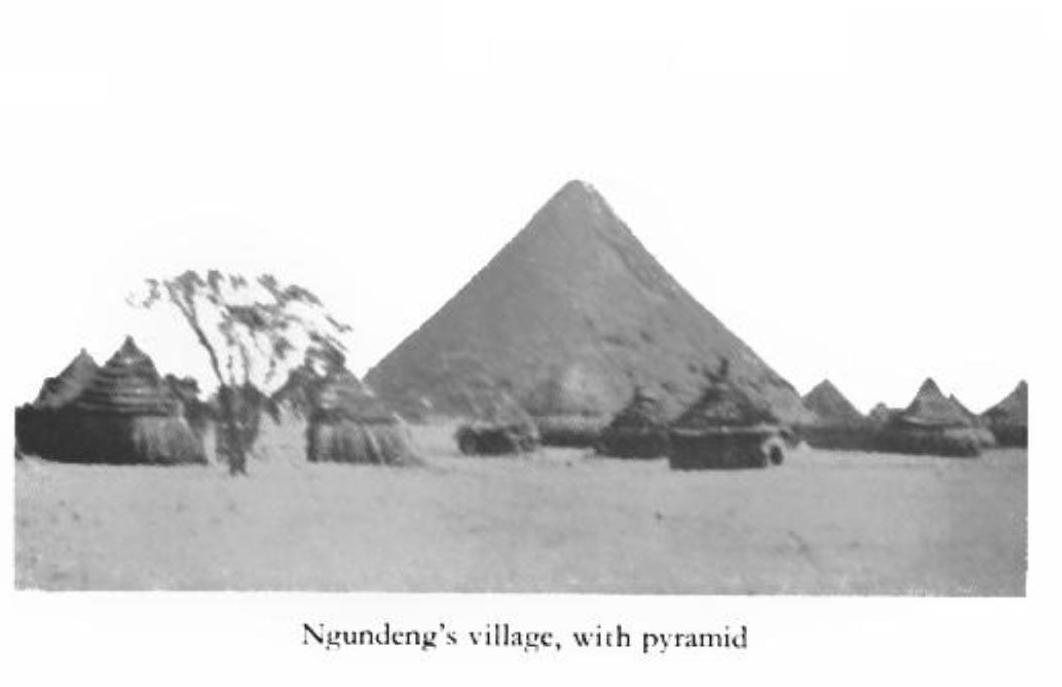
Dengkur 1The Nuer are one of the largest groups of Nilotic peoples in the South Sudan. As with other Nilotes, their origins and history are as yet poorly understood. A traditional political system is difficult to identify within Nuer society, which anthropologist E.E. Evans-Pritchard once described as “organized anarchy.” The leopard-skin chief is a figure of priestly rather than political authority, and Nuer tended to organize under central leadership only when faced with an unusual outside threat. Even then, the unification of different Nuer groups under a single individual was extremely rare. Evans-Pritchard, whose work on the Nuer was long a staple of college anthropology courses, tended to overemphasize the egalitarianism of Nuer society, ignoring the emergence of a so-called “aristocratic” class of Nuers.

The Nuer prophet Ngundeng was born sometime between 1850 and 1860, and was a member of a leopard-skin clan of the Lou Nuer. Members of such a clan were often referred to as kuaar muon, or earth-priests, as they were felt to have a mystical relationship with the soil. Since the prosperity of all Nuer was closely tied to the earth, such figures occupied an unusual position as potential mediators between various factions of the Nuer, who were habitually involved with blood-feuds and other mutual antagonisms. Ngundeng is usually thought to have been of Dinka descent, the Dinka being the largest of the Nilotic tribes of the South Sudan. Ngundeng spoke Dinka fluently, and was familiar with Dinka manners and customs. As other young Nuer men learned to hunt and fish, Ngundeng spent his days fasting, mumbling incantations and speaking in tongues, earning as well a reputation for being able to self-levitate and to transform himself into a goat. It is said that, as a youth, he deprived anyone who displeased him of the power of speech (save his mother, who was immune), and as a result many of his village neighbors moved to more remote parts. In his early days as a prophet, Ngundeng was said to live for weeks in the bush by himself, surviving on animal and human excrement. He later developed a taste for re-cooked ashes. Evans-Pritchard considered him a genuine psychotic, but nevertheless, Ngundeng’s growing reputation brought him an unusual amount of wealth and wives. It should be noted that the eating of unclean food was also characteristic of the Judaic prophets, and is related to an inversion of normal modes of behavior that helps set the prophet apart from the ordinary individual.

When his first son was born, Ngundeng announced that the particular spirit that the particular spirit that possessed him was called Dengkur, “Deng” being a Dinka word for God, and “kur” being a Nuer term for angry.

At a time just prior to the construction of the pyramid the Gaajok Nuer women were enduring a period of general infertility. In return for curing these women of their barrenness, usually by spitting on them (a traditional means of bestowing blessings in many parts of the Sudan), Ngundeng accepted payment in the form of ivory tusks, beads and cattle. At the same time, smallpox was striking the Nuer, and their cattle were afflicted with rinderpest. Ngundeng came up with the idea of burying the plagues beneath a huge mound that would contain them. Such an idea was revolutionary for the Nuer, who were entirely unaccustomed to extensive or sustained cooperative labour.

The work, which began about 1870, was carried out in three stages: first was the construction of huts for the workers, and while these were being built Ngundeng required payment for his services in grass, timber or labour. This phase lasted one winter season. The second phase lasted two years, and consisted of the accumulation of grain and corn, usually brought to the village by any visitor of passer-by who did not wish to incur the wrath of Ngundeng. When the granaries were full, Ngundeng went into seclusion, fasting for seven days, followed by passing into a trance for three days. At this time word went out for the Nuer to congregate at Ngundeng’s village. The Nuer, forgetting all their customary blood feuds, gathered from points all over the South Sudan until, so it is said, the plain was black with people. After exhorting the crowd for an entire night under a full moon, Ngundeng carried the first load of earth to the site of the mound. For four years, thousands of Nuer worked under his supervision constructing the Bie Dengkur, the mound of Dengkur.

The construction of large mounds built of ash, cattle dung, cotton soil and clay was not without precedent in the South Sudan, though it had not been known among the Nuer previous to Ngundeng’s time. These works are variously said to have been made as monuments to the prophets who ordered their construction, or as burial mounds for the prophets, who were buried, sometimes alive, either beside or beneath them. The model for their shape appears to be the only non-domestic structure traditionally built in the South Sudan, the cattle hut. Two very prominent Dinka mounds can be mentioned in this regard; being those of Ayong Dit and Pwom Ayeuil. The first is built north of Malakal, and remains, like the other, an important shrine. This mound, known as Yiek Ayong, is said to have been built over the body of Ayong Dit, who was bricked up by his own orders in his cattle hut with his wife and eight favorite bulls. A ceremony was held every eight years, during which the mound was repaired and eight bulls sacrificed.

The second mound, known as Pwom Ayeuil (the mound of Ayeuil), is situated on the island formed by the Bahr al-Zeraf and the Bahr al-Jabal. The mound is the work of the Luac Dinka, who are known to have been driven from this area in 1820, and must therefore predate this event, making it at least 180 years old. Beside this monument, which is now much weathered and reduced in height by years of heavy rain, is the grave of Ayeuil Longar, the reputed ancestor of no less than five sections of the Dinka. Traditional tales tell of the many deaths of workers on the mound and the incorporation of their corpses into the structure. Other tales tell of human bodies being used as props in the scaffolding, the individuals being buried alive in the construction of the mound. The Dinka word for these mounds, yik, is also used in describing the mound of Dengkur, suggesting a direct relationship between the Ngundeng project and the earlier Dinka mounds.
The mound of Dengkur was some 300 feet in circumference and 50 to 60 feet high, surrounded by a row of elephant tusks. In form it was a perfect cone; the term “pyramid” is the one applied to it by British colonial administrators. Other tusks were buried within the centre of the mound, along with the horns of a white bull, the entrails of a goat, and various bones. The use of elephant tusks was more than decorative; in Nuer cosmology, elephants possess a spiritual power linked to the destiny of men and were in some ways regarded as cousins to the Nuer. At the peak of the mound was a spear decorated with an ostrich egg and ostrich feathers.

In the years following the completion of the Bie Dengkur, Arab slavers twice attacked the area and carried off all the people and ivory they could, but the mound was kept in good repair and served as a rallying point for Nuer warriors. At some point during this difficult period, Ngundeng had an elaborate brass pipe made for him by an Anuak craftsman. The manufacture of this object was kept secret until one morning the astonished Nuer observed the pipe sitting by itself at the peak of the mound with smoke issuing from its bowl. The pipe quickly assumed its own magic, being said to render its possessor invulnerable, as well as serving as a death-dealing weapon, reputedly felling both men and cattle at a mere wave. Ngundeng let it be known that the pipe would play a major role in ridding Nuer country of the hated “Turks,” as Ottoman, Egyptian and British forces were all known. Ngundeng died in 1906, before the final struggle between the “Turks” and the Nuer.

Ngundeng had become the father of twin sons, Gwek and Lil, in 1883, but it was initially felt that the spirit of Dengkur had passed to his eldest son, Reth. It was Gwek, however, who appeared to have been possessed by Dengkur, speaking in tongues, standing on his head atop the mound, and allegedly transforming himself into a goat. Goats were normally associated with women and cattle with men; the transformation into a goat is again a type of behavioral inversion associated with sexual ambiguity. The matter of Gwek’s status was sealed when Gwek was spotted smoking the brass pipe on top of the mound, for the pipe had not been seen since Ngundeng’s death, presumably having accompanied him to the spirit world. The name “Gwek” means “frog,” and was said to have been given to him as a result of Ngundeng feeding Gwek’s mother frogs as a method of increasing her fertility. Those who knew the adult Gwek felt the name was especially suited to this short, squat, large-headed individual who was known for drooling at the mouth. Quite likely Gwek was an epileptic, experiencing seizures almost daily, during which he would shake, foam at the mouth and scream at the top of his lungs, quite often while standing atop the mound. The Nuer did not haphazardly appoint madmen or epileptics (gwan noka) to positions of authority. Symptoms of epilepsy could only be regarded as signs of prophethood when they were accompanied by a perceived success in curing barrenness, healing, rain-making, divining the future, stopping epidemics and leading raids. The sociologist Max Weber classed such people as “charismatic berserks.”

No one ever saw Gwek climbing or descending the mound; one British officer making a visit to the village thought that Gwek would go up in the night and descend the next night, but he was unable to observe him doing either, despite his best efforts. Climbing the mound was no easy feat, as another British officer later found out. The sides were exceptionally smooth with no handholds. After reaching the top with the assistance of a native trooper, the officer described his descent as “an involuntary and painful slide.”
Although the Anglo-Egyptian army had taken control of the Sudan in 1898, it was not until 1916 that patrols were sent into Nuer country in the Upper Nile province. The Nuer prophets were noted by the administration as having been responsible for leading raids against neighboring tribes, a practice that continued into the 1940s. By 1918, Gwek was leading large raids against the Dinka and even massacred a company of the 9th Sudanese Regiment. Gwek normally went into battle carrying his pipe and a magical fishing spear (normally a ritual object associated with the Dinka) and leading a white bull – an animal that was especially associated with rain-making ceremonies and accompanied Nuer prophets on raids against the Dinka. A government patrol in 1918 met Gwek’s advance on them with a burst of machine-gun fire. The bull was killed with its head pointing towards the Nuer, a signal for immediate retreat.

HC Jackson, then Deputy Governor of Upper Nile province, visited the mound in 1921 with a small escort of native police. Gwek refused to see him, and the small group was soon surrounded by a large number of angry warriors. With little chance of being able to fight their way out, Jackson defused the situation by breaking out his canvas field bath and having an impromptu bath, much to the amusement of the warriors.

Relations between Gwek and the government deteriorated, however, as courts and a native police force were established, greatly reducing both Gwek’s authority and his income. The situation grew worse as the government proposed building a road through Nuer country, connecting it with the territory of their traditional rivals, the Dinka. Over 20 years earlier, Ngundeng had made a prophecy that the Turks would defeat the Nuer in battle many times before making “a great white path” to the Nuer border. At that point a plant would sprout atop the mound of Dengkur. When it reached the height of a man, the Nuer would rise up and drive the Turks out forever. Soon hundreds of bulls were being sacrificed at the base of the mound and warriors began to arrive from all over Nuer land, including forces under the leadership of two other prophets, Char Koryom and Pok Karajok. In 1927, District Commissioner Captain V.H. Fergusson was allegedly murdered along with a Greek merchant and a number or Dinka bearers by a group of Nuer, an action that resulted in an order to arrest Gwek. The perceived threat from the Nuer prophets was even raised in the British House of Commons, and Gwek and Pok Karajok were immortalized in a few lines from the satirical Punch magazine:

I fear that Messsrs. Pok and Gwek
Will shortly get it in the neck
And that an overwhelming shock
Is due to Messrs. Gwek and Pok

Then let us mourn the bitter wreck
In store for Messrs. Pok and Gwek
When we administer the knock
To Mr. Gwek and Mr. Pok.

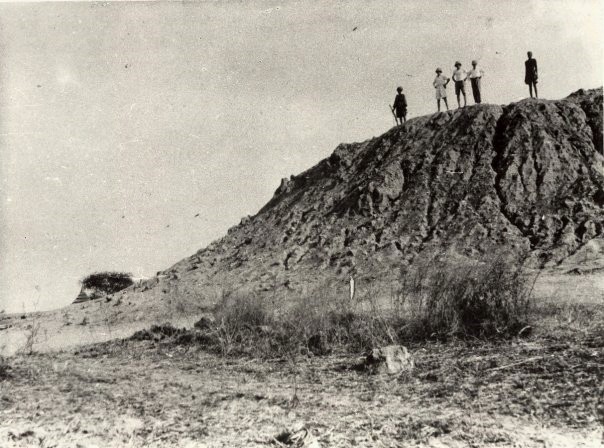
The eventual advance of a large force of government troops succeeded in dispersing the Nuer. When the patrol reached the mound, which by this time was recognized by the government as a symbol of Nuer resistance, a group of engineers spent a week digging a tunnel into the base of the mound, in which they place a charge of high explosives. The Nuer warriors were assembled for a display of government power and told to watch the mound closely, for it would vanish on a signal from the British leader of the patrol. The attempt to destroy the mound was a failure, however. As Percy Coriat, the Nuer-speaking officer involved described it, “a puff of white smoke and a few lumps of earth tumbling down the side was all they saw.” The mound was attacked by the Royal Air Force in 1927, but bombs failed to destroy it. Gwek remained at large and raids and other disturbances continued. In January 1929, another government column was dispatched to the pyramid.
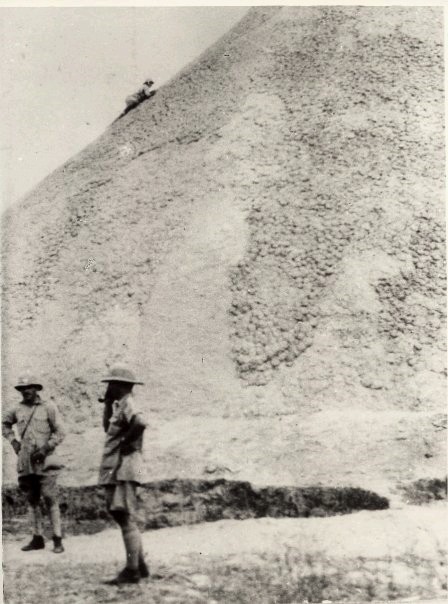
Percy Coriat climbing the “pyramid,” 1928

Arriving at 5:30 in the morning, they found large numbers of spear-carrying warriors dancing at the base of the mound. Magic water was given to the warriors, who were told that it would render them immune to bullets and taxes, while reeds were given out in the understanding that they would be magically transformed into guns once the battle began.
The column formed a square and began firing over the heads of the warriors in an effort to provoke a charge. The shots had their desired effect and soon the Nuer were rapidly advancing, singing and driving Gwek’s white bull before them. When they had reached 120 yards from the square the government troops opened a withering fire that broke the charge. Gwek’s body and pipe were found beside the slain white bull. The prophet had got closer to the square than anyone else. Though the action wasn’t quite the “Battle of the Pyramids” fought between Napoleon and the Mamluks, it nevertheless had as great an impact on the Nuer of the South Sudan, ending for the most part all resistance to the Anglo-Egyptian Condominium government.

After the battle, the British hung Gwek’s body in a tree so that all the Nuer could see that he was truly dead. Gwek’s pipe wound up in the hands of District Commissioner Alban, who liked to shock the local Nuer by having a smoke from it. Eventually it was destroyed in a fire, but the pieces were recovered and presented to the Khartoum Museum.
The ruined mound stood for many years, with the Nuer prevented by the government from effecting any repairs. As late as 1940, a plague of locusts prompted Gwek’s twin brother, Lil, to request that the mound be “closed up” in order to enclose and bury the plague. Permission was refused. Dengkur 2 The Bie Dengkur after its Partial Demolition by Government Forces.
In conclusion, we can see some similarities and differences between the Bie Dengkur and the Old Kingdom pyramids:

1/ The Egyptian pyramids were built at the instigation of a divine (or semi-divine) king, while the Nuer mound was built under the direction of a prophet who acted as a spokesman for God.

2/ In time, the pyramids of the Old Kingdom came to symbolize the over-concentration of power and wealth in one individual’s hands leading to resentment and the looting of these structures as early as the First Intermediate Period. The mound of Dengkur, however, came to serve as both a symbol of Nuer resistance to outside aggression and as a means of controlling some of the more inimical elements of nature.

3/ The Egyptian works served as funerary monuments for the benefit of one individual, while the mound of Dengkur was rather more functional, serving to bury plague and disease for the benefit of the entire community.

4/ Both works assisted, intentionally or not, in the unification of fractious but otherwise homogenous peoples and in the mass organization of labour. In this sense, the pyramids of Egypt were vitally important in the formation of a powerful state; the inspiration of Ngundeng might likewise have enabled the Nuer to assume a politically dominant position in the South Sudan had a more advanced culture not interfered at a vital point in their development of a proto-state.

Bibliography

Alban, A.H.: “Gwek’s pipe and pyramid,” Sudan Notes and Records 23(1), pp. 200-201.

Biedelman, T.O.: “Nuer priests and prophets: charisma, power and authority among the Nuer,” in: T.O. Biedelman (ed.), The Translation of Culture, London, pp. 375-415.

Burton, J.W.: “A note on Nuer prophets,” Sudan Notes and Records 54, pp.95-107.

Coriat, Percival: “Gwek the witch-doctor and the pyramid of Dengkur,” Sudan Notes and Records 22(2), 1939, pp.221-37.

Evans-Pritchard, E.E.: “Customs and beliefs relating to twins among the Nilotic Nuer,” Uganda Journal, 1936, pp.230-38.

Evans-Pritchard, E.E.: The Nuer, Oxford, 1940

Greuel, P.J.: “The Leopard-skin chief: An examination of political power among the Nuer,” American Anthropologist 73, 1971, pp.115-20.

Howell, P.P.: “Pyramids in the Upper Nile Region,” Man 48, 1948, pp.52-53.

Jackson, H.C.: Sudan Days and Ways, MacMillan and Co., London, 1954.

Johnson, Douglas H.: “Foretelling Peace and War: Modern Interpretations of Ngundeng’s Prophecies in the Southern Sudan,” in: M.W. Daly (ed.): Modernization in the Sudan: Essays in Honor of Richard Hill, Lilian Barber Press, New York, 1985

Johnson, Douglas H.: Nuer Prophets: A History of Prophecy from the Upper Nile in the Nineteenth and Twentieth Centuries, Clarendon Press, 1997

Kelly, Raymond C.: The Nuer Conquest: The Structure and Development of an Expansionist System, University of Michigan Press, Ann Arbor, 1985

Kingdon, F.D.: “The Western Nuer Patrol,” Sudan Notes and Records 32, 1945, pp. 77-84.

Stigand, G.H.: “Warrior classes of the Nuers,” Sudan Notes and Records 1, 1918, pp.116-18.

Thomas, L.: “The Nuer Patrol, 1927-28,” in D. Lavin (ed.), The Condominium Remembered: Proceedings of the Durham Sudan Historical Records Conference 1982, Vol. 1, Durham, 1991, pp. 108-110.


A transcript of this lecture was first published in Proceedings of the Near and Middle Eastern Civilizations Graduate Students’ Annual Symposia 1998-2000, Benben Publications for the University of Toronto, 2001, pp. 201-210.
The Circassian Qubba-s of Abbas Avenue, Khartoum: Governors and Soldiers in 19th Century Sudan

Andrew McGregor
Canadian Institute of International Affairs

Nordic Journal of African Studies 10(1), Helsinki, 2001

Abstract:
Departing from two qubba-s, beehive-like tombs from the 19th century in the centre of Khartoum, the author portrays the complicated sequence of power politics in Egypt and in the Sudan, which ‘explains’ the existence of those two burial monuments in an area where most such monuments were destroyed after the Mahdi’s conquest in 1885. These qubba-s are grave monuments of two nineteenth century Circassian governors-general of the Sudan in the service of Viceroy Muhammad ‘Ali and his descendants. In the qubba-s can be seen the passing of an extraordinary age of Circassian prominence in the Nile Valley. Several events contributed to the end of the Circassian importance in international affairs in general and in Egypt in particular, including (a) the elimination of Mamluk recruitment; (b) the conquest of a divided Circassia by Russia; (c) the exile of many Circassians to Turkey, Jordan, and other points in the Middle East; (d) the growth of Arab nationalism in Egypt and other parts of the Ottoman Empire; and (e) the momentous changes in the power structure of the Ottoman government that culminated in the revolution of the Young Turks.

INTRODUCTION

Passed every day by thousands of people in the downtown core of Khartoum are a pair of qubba-s, or large, beehive-shaped tombs. Surrounded today by modern office towers, their quiet and dusty façades barely invite a second glance, and they are probably taken by most passers-by to be tombs of a pair of local shaykh-s, as the qubba-style monument is almost universally associated with Islamic saints in the Sudan. In reality, however, these structures are not religious in nature, but are rather reminders of the great variety of people who arrived in the Sudan in the nineteenth century, some to rule, some to exploit, some to develop and some to colonize. Drawn from Europe, the Maghrab, the Caucasus, the Middle East and even Central Asia, most of these individuals came voluntarily to participate in the opening of this vast country, while others arrived on orders or even in chains as prisoners in forced exile. Notable among these were the many Circassian military men in Egyptian service, often rising from slavery to assume vitally important positions in the Sudanese administration.

The qubba-s on ‘Abbas Avenue are almost unique examples of ‘secular’ monuments of this type in the Sudan as they mark the burials of two nineteenth century Circassian governors-general of the Sudan in the service of Muhammad ‘Ali and his descendants. Many examples of qubba-s devoted to Sudanese holy men are surrounded by subsidiary burials as followers and even later generations hope to partake in the baraka of the shaykh through burial close to his monument. Mimicking this pattern of burials, the secular qubba-s of ‘Abbas Avenue are likewise accompanied by a number of subsidiary graves, including those of a pair of notable native Sudanese officers of the Egyptian army who pursued service as far afield as Greece, the Crimea and Mexico.

After the abandonment of Khartoum following the Mahdi’s conquest in 1885 and the subsequent demolition of all major buildings for materials for the new ‘Islamic’ capital of Omdurman across the White Nile, the Circassian qubba-s became virtually the only intact remnants of the pre-Mahdist Sudanese capital. It would seem logical to assume that these tombs evaded destruction by the religiously inspired Mahdists through their resemblance to the tombs of Islamic holy men, but the reasons for their survival may be much more complex.

1. THE CIRCASSIANS

The Circassians (also known as Cherkess and Adyghe) who occupied the western half of the north Caucasus are among the most ancient of the region’s innumerable ethnic and linguistic groups. By the tenth to thirteenth centuries AD the Circassians began to consolidate themselves on the Black Sea coast, trading with Byzantium and the Mediterranean merchant cities. Among the products dealt were highly prized Circassian slaves, the women esteemed for their beauty and the young men for their military prowess (Allen, 1970). Nominally Christian with many pagan traditions, the Circassians turned to Islam (introduced by Crimean Tatars) in the 17th and early 18th centuries as a reaction to the Russian threat from the north. The Circassians were politically tied to the Ottoman Empire, but disunity amongst the various tribes allowed Russia to militarily penetrate their homeland. In the 1829 Treaty of Adrianople (Edirme), the Ottoman Empire gave up all claims on the fertile Circassian homeland, but in the 1830s a sense of national identity was formed with British and Ottoman encouragement. Foreign intervention on behalf of the Circassians seemed possible during the early stages of the Crimean War, but eventually the Allies (Britain, France and Turkey) decided to make a landing on the Crimean peninsula rather than the Black Sea coast, despite Turkish support for military intervention in the Caucasus. Major Russian operations resumed in 1862, and after 35 years of nearly constant warfare, Circassian resistance collapsed in 1864, with four to five hundred thousand Circassians being driven from their lands into ships destined for Turkey. Heirs to a proud warrior tradition, some Circassian chiefs were said to have ridden their horse into the Black Sea, drowning themselves in full warrior’s regalia. By 1866 as many as one million Circassians had been driven from their homes, many perishing of disease, exposure and starvation in the process. [2] A last effort to retake Circassia came in 1877, when large numbers of Circassians joined in the Ottoman invasion of the Black Sea coast; though initially successful, the attempt was eventually abandoned (Allen and Muratoff 1953). A large Circassian diaspora emerged from this catastrophe, in which the Circassians were dispersed to communities in Turkey, Jordan, Syria and Palestine, though the displaced Circassians continued to have great success in the armed forces and royal guards of their adopted countries. The Circassian homeland was eventually broken into three autonomous republics, Adygea, Karachai-Cherkessia and Kabardino-Balkaria, in each of which the Circassians now form a small minority (Habjoka 1972).

To explain the burial of two Circassian military men in religious-style tombs in Khartoum we must first briefly look back to Egypt in 1260 AD, when the powerful class of military slaves known as Mamluks seized power from their masters and created their own unique dynasty. The Mamluks were not Egyptians themselves, but were instead purchased as boys from dealers in the Caucasus mountains, Turkestan, and even Mongolia. They were succeeded in power not by their own children, but by new slaves imported from far beyond Egypt. In 1382, the Circassian faction of Mamluks from the North Caucasus gained dominance and spent the next 135 years battling each other while terrorizing and pillaging their hapless Egyptian subjects. The Ottoman invasion of 1517 did not end Mamluk authority as expected, but in many cases only supplied the Mamluks with a new series of Ottoman governors to bully and torment.

The end of this system of misgovernment arrived in the person of Muhammad ‘Ali at the head of 10,000 Albanian troops in a combined Ottoman-British invasion of French-occupied Egypt. Seizing power in 1803, Muhammad ‘Ali followed a policy of massacres against the Mamluks while also cutting off the supply of new slaves from Circassia and Georgia.

By 1811, Muhammad ‘Ali had succeeded in destroying the Mamluks as an institution, but the resilient Circassians continued to wield considerable control and influence in Egyptian affairs for the next 70 years, although they were now under the vigilant eye of the Viceroy and his successors. Culturally aligned to the Ottoman Turks through their shared use of Turkish rather than Arabic, the Circassians formed part of a Turko-Circassian elite in Egypt that enjoyed a monopoly on force and the major state offices despite their small numbers. Probably only 1% of the population at the beginning of the 19th century, the supply of fresh Circassian slaves began to diminish under the Viceroy’s rule, and the children of Turko-Circassians began to be raised as Arabic-speaking Egyptians.

Growing numbers of native Egyptian administrators and the concurrent growth of Arabic as the language of government meant that by the 1870s the term ‘Turko-Circassian’ had lost much of its ethnic meaning, instead indicating more of a socio-economic class. The use of Ottoman Turkish in government had long kept Egyptians from public office, but long after the use of Arabic and French had become common in many ministries, the Egyptian Army retained Turkish as the language of command, allowing the Turko-Circassians some leverage in keeping a lingering grip on their previous monopoly on force. [3] The development of a nascent Egyptian nationalism behind Ahmad ‘Urabi was in large part a response to the entrenchment of the wealthy, land-holding Turko-Circassian elite, but many Circassians realized that their grip on Egypt was highly tenuous, and the Circassian nobles and officers split into Ottoman and ‘Urabist factions. With the ‘Urabist nationalists in power, a number of Circassian staff officers attempted a coup in 1882 designed to preserve the old order. The rising was thwarted and the officers were sentenced to exile in the Sudan (later commuted to exile in Turkey by Khedive Tawfiq, a virtual non-punishment) (Cole 1993: 237-238).

Some few hundred Mamluks escaped Muhammad ‘Ali’s wrath by fleeing to the Sudan, and in an effort to eliminate these and to acquire at the same time large numbers of black slaves to swell the ranks of his army, Muhammad ‘Ali sent his son Isma’il to the Sudan at the head of a large invasion force in 1820. Isma’il was also entrusted with the task of exploiting the supposed gold fields of Sinnar. The army was a motley collection of Turkish troops, Bedouin, Bosnians, Magharba volunteers and Bashi-Bazouks, [4] loosely disciplined irregulars (mostly Albanians, Circassians, Kurds and Slavs). The army also included a battery of field artillery, which was to prove decisive in several engagements ahead.

2. THE TURKO-EGYPTIAN CONQUEST OF THE SUDAN

The advance of Isma’il’s force was unopposed until they reached the land of the Sha’iqiya, along the Nile in the region between Korti and the fourth cataract. Proud and warlike, the Sha’iqiya courageously but futilely charged the Egyptian guns in two battles in December 1820. Heavy Sha’iqiya losses on the battlefield were followed by the brutal mutilation of many of the civilian population by Turkish troops. Despite this, the surviving Sha’iqi warriors were recruited into Turkish service and remained among the most effective instruments of force available to the regime until its demise 65 years later.
Reaching Sinnar on the Blue Nile in June 1821, a detachment under the Viceroy’s capable son Ibrahim Pasha received the submission of King Badi IV, ruler of the now decrepit Funj empire. The conquest of Fur-ruled Kordofan was entrusted to Muhammad ‘Ali’s son-in-law, the Daftardar Muhammad Bey Khusraw. [5] Again Turkish guns laid waste to the chain-mailed cavalry of the Fur governor and his Arab allies at the battle of Bara. Only the outbreak of an anti-Ottoman rebellion on the Greek island of Morea prevented a further invasion of Darfur itself.

Turkish troops throughout the new territories were immediately put to the task of enslaving tens of thousands of the Viceroy’s new subjects (as well as their neighbors) and shipping them to Cairo. Isma’il was constantly spurred on by his father, who was desperate to fill the ranks of the nizam al-jadid, his new army of black slaves and Egyptian fellahin (agricultural peasants). Muhammad ‘Ali stated these recruits were ‘worth even more than jewels’ (Douin 1944: 277-285).

Massive new tax levies were instituted to compensate for the failure of the Turks to discover the long rumoured gold sources of Sinnar and Kordofan. While the early years of the occupation might be termed ‘rule by razzia,’ there were exceptional administrators such as ‘Abdin Bey al-Arna’ut (‘the Albanian’), who made many improvements as governor of Dongola (1821-26). The stability of Dongola was unusual, however, as rebellion flickered throughout the new Egyptian territories.

On an inspection tour of Shendi in 1822, Isma’il made insulting and unreasonable demands for slaves and cash from the Ja’aliyin mek (king), Nimr Muhammad. Mek Nimr responded by uniting with his cousin Mek Musa’ad to brutally kill Isma’il and his entourage. With Muhammad ‘Ali’s new heir Ibrahim needed in Egypt to deal with rebellious fellahin, the suppression of the Arab revolt that followed Isma’il’s death was left to the Daftardar, Muhammad Bey Khusraw, who accomplished the task through massacres and relentless cruelty towards the rebels and the innocent alike. Before being relieved in 1824, the atrocities carried out by the Daftardar in Sudan coloured Sudanese attitudes towards the ‘Turks’ for the remainder of their administration. Muhammad Bey Khusraw was eventually judged a liability by his father-in-law, the Viceroy, and was poisoned on the Viceroy’s orders in 1833.

The administration of the Turko-Egyptian regime changed little with the arrival of a new governor for Sinnar and Berber at the head of a regiment of the nizam al-jadid. ‘Uthman Jarkas al-Birinji was a middle-aged Circassian Mamluk of the Viceroy’s household who attempted to revive the Mamluk style once in Sudan by recruiting fourteen other Mamluks as a personal bodyguard. These efforts brought admonishment from the Viceroy, and ‘Uthman’s brutal attempts to collect the excessive taxes drove the all-important cultivators of the fertile Gezira region into the desert to perish of starvation and disease.

After ‘Uthman’s sudden death in 1823 he was replaced by a Kurd, the Mamluk Mahu Bey Urfali. Mahu accomplished much in his single year as governor, pacifying the country, suspending tax collection for three years, decentralizing the administration and restoring discipline to the marauding troops. Nevertheless, the Viceroy desired another hand at the helm, and installed ‘Ali Kurshid Agha as the Sudan’s first hikimdar (governor-general) in 1826.

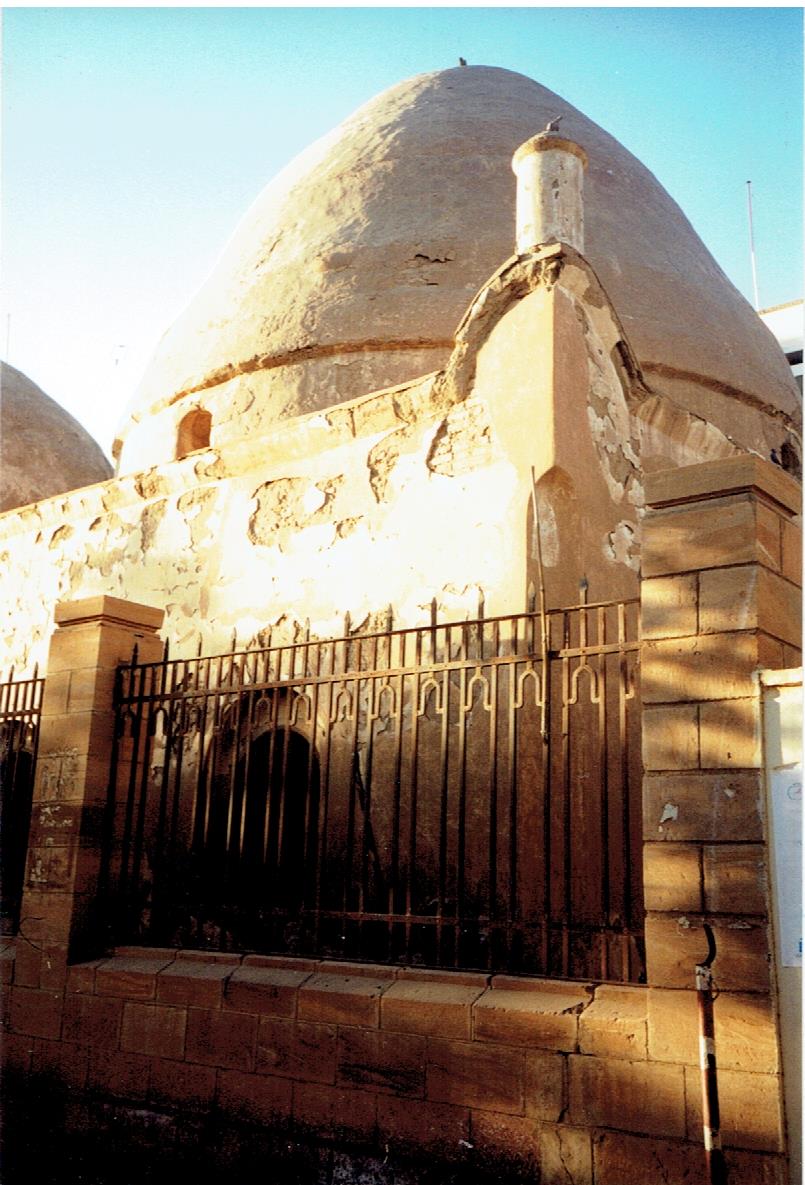
Ali Kurshid was given wide powers, but discovered his new domain was already in ruins after only five years of Turko-Egyptian rule. The hikimdar’s rule, which lasted until 1838, was characterized by a number of important developments, including the establishment of Khartoum as the new capital of the Sudan, the introduction of a number of new crops, the growing cultivation of cotton, and the revival of the Gezira region. ‘Ali Kurshid also worked hard at organizing the slave trade and mounted numerous raids on the Shilluk, the Dinkas and the Hadendowa, many of which met fierce resistance (Hill 1959; Udal 1998; Douin 1944).Qubba10 001Qubba of Ahmad Pasha Abu Adhan (McGregor)

3. THE QUBBA OF AHMAD PASHA ABU ADHAN

Muhammad ‘Ali’s conquest of the Sudan gave ambitious Circassians a new field in which to resume their ruling ways at some distance from the ever-suspicious Viceroy while still being officially engaged in his service. The qubba-s in downtown Khartoum memorialize two such men.

The first of these is Ahmad Pasha Abu Adhan, Governor-General of the Sudan from 1839 to 1843. Brought to Egypt as a Circassian slave, Ahmad Pasha was a career soldier who fought under Muhammad ‘Ali’s son, Ibrahim Pasha, in Arabia, Syria and Greece. After serving as Egypt’s Minister of War, Ahmad Pasha’s first task as Governor-General was an eight-month campaign undertaken in 1840 to subjugate the Hadendowa tribe of the Beja in the east part of the Sudan. Taking Kassala following heavy fighting, Ahmad Pasha then embarked on a large raid into the Blue Nile area in search of slaves for Muhammad ‘Ali’s army. According to one source, his force of nearly 5,000 men and artillery was soundly routed by a desperate charge of spear-carrying tribesmen at Kormuk (Paton 1863: 227-231). In 1843 Muhammad ‘Ali ordered the preparation of a large force to invade Darfur, an independent sultanate west of the Sudan, but the operation was called off at the last minute because Muhammad ‘Ali began to suspect Ahmad Pasha of treasonous activities.
While governor, Ahmad Pasha made a number of innovations in the administration of the Sudan, including the development of the manufacturing sector of the country, the imposition of a levy of slaves upon each taxable person, and a crackdown on government corruption, especially among the Coptic financial clerks who used the mysteries of accounting to fleece their Turkish masters. The Governor-General was especially popular with the black troops of the Egyptian army, which eventually caused Muhammad ‘Ali to regard him as a threat to his own rule. The Viceroy could well recall that it was his own popularity with the Albanian troops serving in Egypt that enabled him to seize control, though Muhammad ‘Ali would later take pains to eliminate his unruly supporters by sending them off to fight in expeditionary forces accompanied by letters to their commanders advising them that these men were to considered ‘expendable.’

When rumours began to circulate that the Governor-General was negotiating with the Ottoman sultan to separate the Sudan from Egypt, Ahmad Pasha was ordered back to Cairo. The Governor-General apparently decided instead to take a fatal dose of poison in Khartoum, though rumours held that the poison had been administered by Muhammad ‘Ali’s messenger. The Governor-General’s family was detained in Khartoum for a year afterwards in an attempt to suppress speculation, and the whole incident was regarded as something of a scandal in Istanbul. [6]

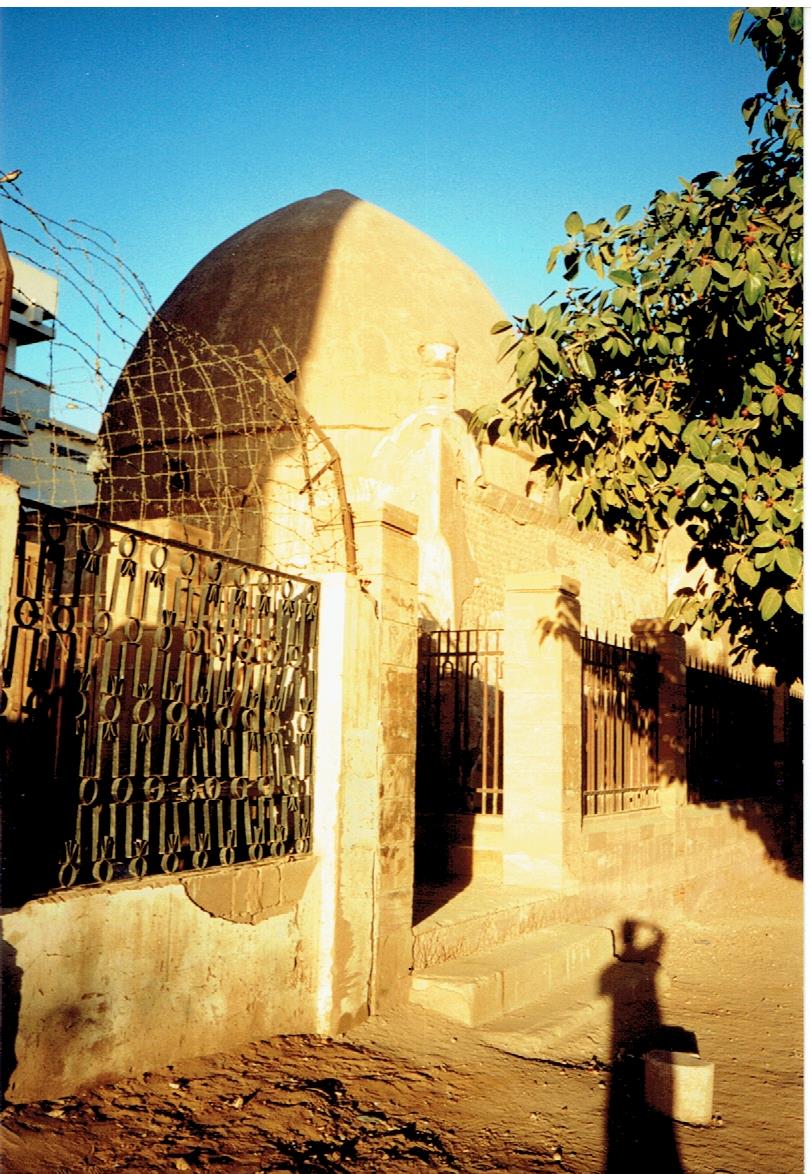
Qubba12 001Qubba of Musa Pasha Hamdi (McGregor)

4. THE QUBBA OF MUSA PASHA HAMDI

The Western qubba on ‘Abbas Avenue is that of Musa Pasha Hamdi, Governor-General of the Sudan from 1862 to 1865. Musa Hamdi was a Circassian soldier of long experience in the Sudan. His career began when he was sold as a slave in the Cairo market to a Turk. Enrolled in the army, Musa Hamdi was captured in a campaign against the Syrians, but succeeded in escaping. Musa Hamdi progressed quickly through the ranks due to a combination of cunning and ruthlessness, and despite being dismissed at one point for his inhumane treatment of prisoners (an accomplishment at a time when taxes were collected through beatings and conscripts were transported in chains), Musa Hamdi was soon appointed to a succession of important posts. When made Governor-General, Musa Hamdi brought with him a reputation for cruelty demonstrated in campaigns against the Beja in the eastern Sudan. Although several of his predecessors had taken steps against the Sudan’s immense trade in slaves, Musa Hamdi allowed the slave trade to resume unhindered. Taxation was also raised to unsustainable levels and it was not long before the Sudan’s administration became a net drain on the Cairo treasury. In the south the Governor-General came into conflict with several of the often-large private slave armies created by Nubian and Arab traders and slavers from the north Sudan. A successful raid on Abyssinia resulted in Musa Hamdi’s promotion to the third grade of pasha (Rumeli beylerbeyi), but a later expedition against the Nuba of Southern Kordofan ended in defeat for the Governor-General. Musa Hamdi solved the problem of a large and under-utilized army in the Sudan by loaning regular troops to slave-raiders in the South. The Governor-General’s short rule ended with his death from smallpox in Khartoum in 1865. His successor defamed him as ‘a drunkard, a gambler, and a thief,’ though it was the practice for new governors to denigrate their predecessors so as to make their own regimes shine in comparison. Samuel Baker, who knew the Governor-General, described Musa Hamdi as ‘a rather exaggerated specimen of Turkish authorities in general, combining the worst of oriental failings with the brutality of a wild animal’ (Baker 1877: 8). HA MacMichael, a later Governor-General of the Sudan, remarked of Musa Hamdi that ‘murder and torture were no more to him than pastimes’ (MacMichael 1922: 429).

5. THE TOMB OF MUHAMMAD BEY ALMAS

As mentioned above, Islamic qubba-s are typically surrounded by the graves of followers and descendants of the shaykh within, a pattern followed by the monuments of ‘Abbas Avenue, which are accompanied by a handful of lesser burials. Among these is that of Muhammad Bey Almas (or al-Maz). A Dinka from the south Sudan, Muhammad Almas entered the Turkish-Egyptian army as a common soldier in 1834 and eventually rose to the rank of commissioned officer.

Far from the Sudan, the manipulations of the French emperor Napoleon III in Mexico were to have an unforeseen effect on the lives of Almas and many of his fellow Sudanese comrades-in-arms. Napoleon III committed a large number of French troops in 1862 to support the ambitious attempt to place a Hapsburg royal on the throne of Mexico, but Yellow Fever and malaria proved devastating to the French troops. The French Emperor was increasingly involved financially with Egypt, and his request for the loan of black troops used to such conditions for use in the most fever-ridden areas was met with approval. By January 1863 Muhammad Almas was on his way to Mexico as second-in-command of 447 Sudanese soldiers, assuming command of the regiment shortly after the death of its commanding officer, Binbashi Jubarat Allah.

The Sudanese proved very effective fighters and became highly popular with their French allies. [7] Almas was personally decorated by the Hapsburg Arch-Duke Maximillian with the order of Our Lady of Guadeloupe, a singularly unusual distinction for a Muslim officer. A much-reduced Sudanese force embarked for the return to Egypt in 1867, stopping along the way for a review by Napoleon III in Paris. Almas was decorated with the cross of Officer of the Legion of Honour by the French emperor,and was further promoted upon his return to Egypt. The Mexican veterans proved a remarkably durable lot, serving as the most reliable troops under successive governors of the Sudan. Gordon gave the highest commands to Mexican veterans in his defence of Khartoum, and several served long enough to participate in Kitchener’s 1899 conquest of the Mahdist forces at Omdurman. [8]

6. THE TOMB OF ADHAM PASHA AL-‘ARIFI

A second military burial at the site is that of Adham Pasha al-‘Arifi (commonly called al-Taqalawi). Born in the Nuba hills of Southern Kordofan, al-‘Arifi, probably a Nuba in origin, was one of the first black Sudanese to be taken to Egypt for a military education. After his training, al-‘Arifi fought in Muhammad ‘Ali’s campaigns in Syria before serving as second in command of a regiment of Sudanese troops (the 9th) sent to the Crimea in 1853 as part of the Ottoman expeditionary force. After fighting the Russians, al-‘Arifi returned to the Sudan in 1862, where he embarked on a tax-collecting campaign in the Fazughli mountains of the Blue Nile region. In 1865 Cairo issued orders for a battalion to be formed from black troops stationed in Kassala for the relief of the Sudanese battalion already in Mexico. The Kassala garrison mutinied, and al-‘Arifi was placed in command of one of three columns sent to suppress the mutineers. Al-‘Arifi persuaded the garrison to surrender, but they were then executed to a man, despite Al-‘Arifi’s protests. His own role in the affair nevertheless brought al-‘Arifi promotion and eventually the post of acting Governor-General  in 1872 while serving as commanding officer of all troops in the Sudan (Hill 1967: 27).

Several other tombs are found on the site, including that of the wife of Mari Bey. Mari Bey (also known as Békir Agha, and Békir Bey) was a Corsican adventurer who claimed to have served under Napoleon as a colonel, though others insisted he was only a drummer; hence his nickname, ‘Le Colonel Tapin’. Appointed an instructor in Muhammad ‘Ali’s army, Mari Bey campaigned against the Wahhabites in Arabia and against the Greeks in Morea. By 1834 he was on the staff of Ahmad Pasha in Arabia. While serving as a prefect of police in Cairo in 1853 he fell into disfavour with ‘Abbas I and was temporarily exiled to Khartoum, where his wife died and was buried beside the qubba of his old commander, Ahmad Pasha.

The last tomb on the site belongs to Ibrahim Bey Marzouk, an Egyptian writer who appears to have been of some influence in Khartoum, having once served on a commission of inquiry regarding government corruption.

7. THE QUBBA-S

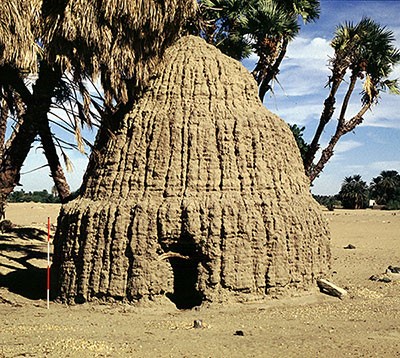
 The Sudanese Qubba in its most basic beehive form – Northern Dongola Reach, Nubia (Sudan Archaeological Research Society – Northern Dongola Reach Survey)

Qubba-s are found mainly along the Blue Nile and the Nile north of Khartoum, though isolated examples are found through most of Muslim Sudan. The qubba is always a holy place, and the fenced area around it is also haram, a sanctuary where a traveler’s goods can be left safely and without interference. The qubba-s are sites of local pilgrimage on holy days, or on occasions when it is necessary to make a special request from the saint. A solemn oath may also be sworn at a qubba belonging to a family ancestor.

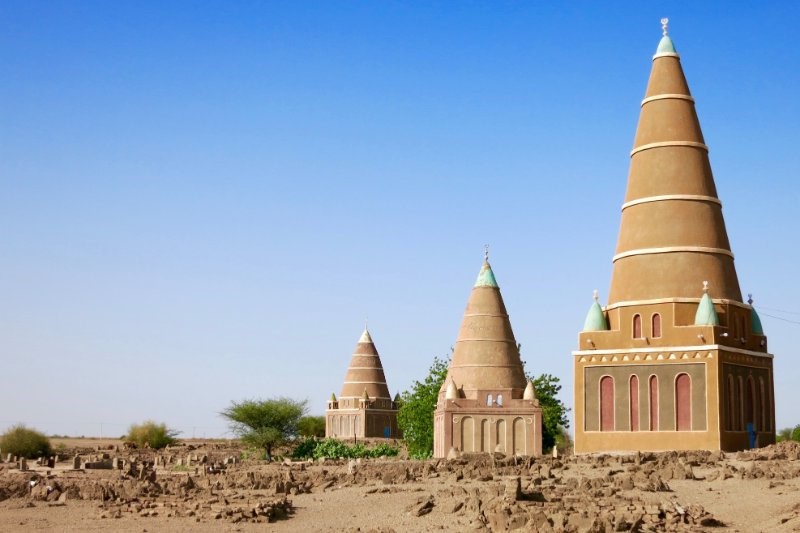
More complex examples from Wad Madani on the Blue Nile (Photo – David Love)

The qubba of Ahmad Pasha, the earlier of the two on ‘Abbas Avenue, represents the beginning of the last phase of development of Sudanese qubba-s, using a cube foundation with a beehive cupola, the two being mediated by a polygon in the middle. In the ‘Abbas Avenue examples and in another qubba at Mekali (that of Al-Shaykh ‘Abd Allah al-Halengi) each of the foundation corners supports a phallic-shaped column. This type of ornament evolved into a more elaborate small dome supported by four open arches, as in the Mahdi’s tomb and others in Omdurman (as-Sadig 1966; Humudi 1977: 107-116).

How did these small burial structures on ‘Abbas Avenue come to be the last remnants of pre-Mahdist Khartoum? Their outward appearance as religious sanctuaries does not appear sufficient reason when the historical record is examined. The tombs were those of major figures in the hated Turko-Egyptian regime, and while the vast majority of the Mahdists were illiterate tribesmen from the west Sudan, the identity of the occupants of these qubba-s would have been no mystery to Islamic scholars such as the Mahdi or to the many former members of the Turko-Egyptian regime who had fallen in with the Mahdists, and who would know the true nature of the tombs’ occupants or at least be able to read the inscriptions found there. Islamic associations were not alone enough to prevent the destruction of a structure by the Mahdists: the Great Mosque of Khartoum was dismantled for building materials shortly after the Mahdist victory, and it is further known that the Mahdists destroyed the qubba of al-Hasan al-Mirghani (1810-69) in Kassala because of his son’s opposition to the Mahdi and his successor, the Khalifa. In these circumstances it is all the more puzzling as to why these two ‘secular’ qubba-s, representative of the cruelty and extortion of the Turko-Egyptian regime, should have survived the abandonment and destruction of the rest of the city.

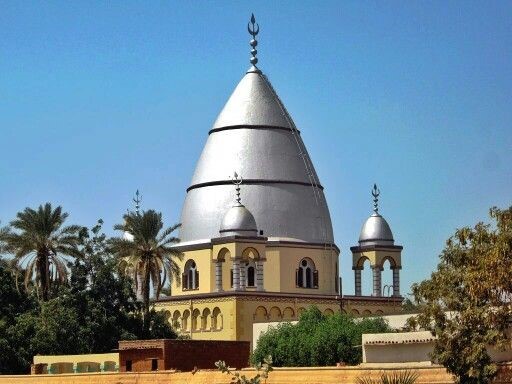
The Qubba Tomb of Muhammad Ahmad al-Mahdi, Omdurman

It is suggested that, given the structural similarity between the ‘Abbas Avenue qubba-s and the much grander tomb of the Mahdi in Omdurman, that the Circassian qubba-s served as architectural models for the tomb of the Mahdi, who died very shortly after the fall of Khartoum. As the rest of Khartoum was dismantled, these qubba-s were spared the fate of the rest of the city through their association (however tenuous) with the Mahdi. These tombs, representative of the old order, could owe their preservation to the sanctity of the man who forever destroyed that old order in the Sudan.

What, then, was the legacy of these Circassian governors and their fellow Ottomans during Egypt’s 19th century rule in the Sudan? Before his fateful return to Khartoum, General Gordon insisted in an interview in 1884 (in the Pall Mall Gazette) that ‘all that was needed in order to restore law and order in the Sudan was to promise the Sudanese that in future no Turks or Circassians should be allowed to exploit them and ruin their country’. Lord Cromer, who devised the Condominium government of Britain and Egypt that ruled the Sudan after 1899, described the Turko-Circassian administration of the Sudan as ‘the worst form of misgovernment’. George Schuster, a prominent member of Sudan’s government in the 1920’s, described the regime as ‘one of the blackest stories of misadministration in human history – a record of corruption by Government officials, of slave trading, of local wars and complete civil disorder.’ [9]

Egyptian views of the Turko-Circassian legacy in Sudan vary; some have focused on
Egypt’s ‘civilizing mission’, some have disclaimed Egyptian involvement in what was in reality an Ottoman Turkish administration, and still others have blamed the ills of the administration on the Europeans introduced to the Sudan government by Khedive Isma’il in the 1870’s. Sudanese scholars have used Egyptian correspondence of the period to reject any notion of Egypt carrying out a ‘civilizing mission’ above and beyond the exploitation of Sudanese resources and peoples, and further emphatically dispose of the idea that the Sudanese umma required Egyptian guidance in religious affairs (Warburg 1992).

While the Turko-Circassians did open the Sudan to world markets and created a centralized administration, the devastation wrought by a brutal and wasteful slave trade, the consequent depopulation of viable economic areas, and the use of forced labour on over-ambitious and ultimately unsuccessful attempts to exploit the country’s natural resources meant that the Sudan’s financial books were doomed to drown in red ink even before corrupt administrators of each level of government took their take of the official revenues.

8. CONCLUSION

The small collection of qubba-s and graves on ‘Abbas Avenue are an important monument to the vast changes that came to the Middle East and North Africa in the 19th century. In the qubba-s we may see the passing of an extraordinary age of Circassian prominence in the Nile Valley. Among the events that conspired to bring an end to Circassian importance in international affairs in general and their prominence in Egypt in particular were;

a) the elimination of Mamluk recruitment
b) the conquest of a divided Circassia by Russia
c) the exile of many Circassians to Turkey, Jordan, and other points in the Middle East
d) the growth of Arab nationalism in Egypt and other parts of the Ottoman Empire
e) the momentous changes in the power structure of the Ottoman government that culminated in the revolution of the Young Turks. [10]

On the other hand, we may see in the careers of the two Sudanese officers the entry of the black tribes of the south Sudan onto the modern international scene. Born into a world where most people rarely ventured far from their village, these Nuba, Dinkas, Shilluks and others represented their little known peoples with distinction in such far-flung places as Syria, Russia, France and Mexico.

Though they, like the Circassians, began their Egyptian service as slaves, they were pioneers in the transition of power in the Sudan from the varied ‘Turk’ races of the Ottoman empire to the Sudanese nationalists who would eventually guide the Sudan to independence.

Notes

  1. [AIS Update – December 2016] – The author made several visits to the site in the 1980s and 1990s, which was, at the time, close to a road sign that read “Abbas Avenue.” It was later learned that the avenue had been renamed al-Baladiya Avenue at some point after independence, though apparently the old road signs had not been removed. The qubba-s can be found on al-Baladiya (formerly Abbas) between al-Qasr Avenue and Babiker Badri Street. The author regrets the mistake.
  2. The precise figures have been the subject of some dispute; see Henze (1992: 103-104).
  3.  For the role of the Circassian elite in a changing 19th century Egyptian society, see Abu-Lughod (1967: 325-344).
  4. Turkish: basibozuk, literally ‘crack-brained.’ Lively accounts of service in such units can be found, for example, in Money (1857) and Vizetelly (1897).
  5. The Daftardar was the Egyptian government Intendant of Finance.
  6. Hill 1967: 41-42. For details of the controversy, see Santi and Hill (1980: 87-89) and Hill (1956: 83-87).
  7. The Sudanese and French were only part of a polyglot force that included Austrians, Belgians, Mexicans, Legionnaires and Martinicans.
  8. A full history of the Mexican campaign is given in Hill and Hogg (1995). A colourful first-hand account can be found in Jifun (1896). See also Ravert and Dellard (1894: 43-53, 104-23, 176-85, 230-45, 272-85).
  9. Gordon is quoted in Daniel (1966: 426). For British views of the Turko-Egyptian regime, see Schuster (1979) and MacMichael (1934: Ch. 3).
  10. The post-Communist efforts to unite the Circassian diaspora are described in Smith (1998 : 92-95).

REFERENCES

Abu-Lughod, I. ‘The Transformation of the Egyptian Elite: Prelude to the ‘Urabi revolt’.
Middle East Journal, Summer 1967: 325-344.

Allen, W. E. D. 1970. Russian embassies to the Georgian kings (1589-1605). Volume 1. Cambridge: Haklyut Society.

Allen, W. E. D. and Muratoff, P. 1953. Caucasian battlefields: A history of the wars on the Turco-Circassian border, 1828-1921. Cambridge.

as-Sadig, S. O. 1966. The Domed Tombs of Eastern Sudan: Their functional, cultural and psychological values. Unpublished MA Thesis, University of Khartoum.

Baker, S. W. 1877. The Albert N’yanza. London.

Broxup, M. E. (ed.) 1992. The North Caucasus barrier: The Russian advance towards the Muslim world. London.

Cole, J. R. 1993. Social and cultural origins of Egypt’s ‘Urabi movement. Princeton, New Jersey.

Daniel, N. 1996. Islam, Europe and Empire. Edinburgh.

Douin, G. 1944. Histoire du Soudan Égyptien, Vol.1, La Pénétration, 1820-22. Cairo.

Habjoka, S. M. 1972. Heroes and Emperors in Circassian History. Beirut.

Henze, P. B. 1992. “Circassian resistance to Russia,” In: The North Caucasus barrier: The
Russian advance towards the Muslim world, Marie Bennigsen Broxup (ed.). London.

Hill, R. 1956. ‘Death of a Governor-General,’ Sudan Notes and Records 37.

Hill R. 1959. Egypt in the Sudan, 1820-1881. Oxford.

Hill, R. 1967. Biographical Dictionary of the Sudan, 2nd ed., Oxford

Hill, R. and Hogg, P. 1995. A Black Corps d’Élite: An Egyptian Sudanese conscript battalion with the French army in Mexico, 1863-1867, and its survivors in subsequent African history. Michigan: East Lansing.

Humudi, S. T. 1977. ‘Arab and Islamic origins of the tomb and enclave in the Sudan.’ Sudan Notes and Records 58: 107-116.

Jifun, A. (Translation: Bey, P. W. M.) 1896. ‘The Story of Ali Jifun,’ The Cornhill Magazine, new series 1. London.

MacMichael, H. A. 1922. History of the Arabs of the Sudan, Vol. II.1934

MacMichael, H.A., 1934. The Anglo-Egyptian Sudan. London.

Money, E. 1857. Twelve Months with the Bashi-Bazouks. London.

Paton, A. A. 1863. A History of the Egyptian Revolution, Vol.II. London.

Ravert and Dellard 1894. ‘Historique du Bataillon Nègre Égyptien au Mexique (1863-1867).’
Revue d’Égypte I.

Santi, P. and Hill, R. (eds.) 1980. The Europeans in the Sudan, 1834-1878. Oxford.

Schuster, G. 1979. Private work and public causes. Wales: Cowbridge.

Smith, S. 1998. Allah’s Mountains: Politics and war in the Russian Caucasus. London.

Udal, J. O. 1998. The Nile in Darkness: Conquest and Exploration, 1504-1862. Wilby:
Norwich.

Vizetelly, E. 1897. The Reminiscences of a Bashi-Bazouk. Bristol: Arrowsmith.

Warburg, G. R. 1992. Historical discord in the Nile Valley. London

Photos by Andrew McGregor are © 2016

The Christian Fortifications of Nubia

Andrew McGregor

May 12, 1995

Introduction

Parts of Nubia are a virtual open-air museum of mediaeval fortifications where successive generations and cultures have left samples of military architecture ranging from walled villages to imposing castles. Many of these works belong to the Islamic/Turkish period; most of the earlier Christian works were rebuilt or heavily modified in this era, adding to the difficulties of cultural identification. In this, the Muslims were only following the pattern set by the Christians, who had in their time rebuilt Pharaonic, Kushite, Meroitic and Roman structures.

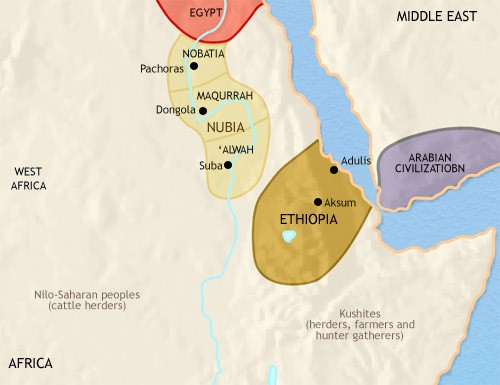
Christian Nubia c.500 C.E.

Unfortunately, these important works have received scant attention from professional archaeologists. Proper surveys are rare and full-scale excavations almost unheard of. Our knowledge of many of these sites relies upon the observations of civil and military officials of the Anglo-Egyptian Condominium who, with varying degrees of skill, attempted to date the ruins they came across on the basis of ceramic remains or brick-types. It is therefore entirely possible that upon closer investigation many of the sites identified in this paper may belong to other periods than those cited, and may likewise possess designs and features dissimilar to those described.

In examining the Christian sites, it is useful to keep in mind the various roles which the fortifications in Nubia could fulfill:

  • Control of river-traffic
  • Demarcation of political boundaries
  • Refuge for local populations in times of attack or upheaval
  • Housing for military and civil administrators
  • Symbolic value as symbols of government prestige
  • Customs house
  • Storage of government taxes and revenues
  • Internment of civil or political prisoners

This paper will examine the Christian sites by type of fortification:

1/            Walled settlements

2/            a) 2-storey houses; b) Blockhouses

3/            Re-used fortifications

4/            Forts/Castles of the Christian Kingdoms

a) Nobatia; b) Makuria; c) Alwa

Walled Settlements

The earliest of the Christian period walled settlements are notable for the strength of their walls and the apparent planning involved in their construction as fortified towns. This type is exclusively found in the northern extremes of Nubia, and its development is likely a response to the proximity of Egyptian military power and the raiding of regional nomads.

The sites, which include Kalabsha, Sabagura, Shaykh Da’ud and Ikhmindi, are characterized by large square or rectangular plans, enclosed by a massive stone wall equipped with bastions, corner towers and fortified gateways. [1] Stone and brick were both used in these defenses. [2]

The walled settlement in points further south is usually less elaborate, consisting of a dry stone wall that follows the terrain or the outline of a pre-existing village. Near Gemai a small settlement of 30 dwellings at Mugufil Island uses its position on a high bluff and a stone wall one meter in width for defence. [3] Close to the Second Cataract, in the Sarkamatto District, the village of Debba brought 70 houses together on a 20 meter high rock outcrop with dry stone walls. [4]

In the Dal district there are two major sites, Tiine and Sheeragi. [5] Tiine is a Late Christian settlement, built on a steeply rising island slope. The east side falls away in a sheer cliff. A semi-circular series of walls adapt to the contour of the hill, creating numerous small enclosures. The repetition of walls down the sloping face provided added defensive protection and a buffer against rock falling from higher levels of the site. Sheeragi also occupies a granite outcrop. Within a stone wall are dozens of houses and two larger works made of granite and schist, which may be the remains of a two-storey house.

South of the Second Cataract, on the island of Gergetti, a small community of 11 houses possessed a well-built double wall, the inner of rough stone and the outer of brick with a finished surface. The plan is in the form of an elongated hexagon, with bastions at the angles. The entrances were built with a zig-zag design and sloping ramps. [6] At Kitfogga (Ferka West), a fortified village uses the natural crest of the hilltop for the plan of its stone-walls. A church and smaller stone dwelling enclosures fill the interior. [7] At nearby Ferkinarti Island (also known as Diffinarti) is a walled village with possible traces of a two-storey house. [8]

Two-Storey Houses

The characteristics of the two-storey house have been clearly defined by Adams:

They are always two storeys high, square or nearly square in plan, and stoutly built; usually of mud-brick but occasionally with a mud brick supper storey resting on a stone-built lower storey. The ground-floor rooms are mostly blind cellars, accessible only from above, while the upper-storey rooms exhibit the typical arrangement of Christian Nubian living quarters. Rarely if ever is there an internal stairway connecting the upper and lower storeys. Many of the buildings lack any ground level access; they were reached originally by means of ladders leading to doorways a the level of the upper storey. [9]

From the evidence of ceramic remains and earlier levels of construction underneath the two-storey houses, it appears that these works are typically Late Christian, mostly of the 13th century. The two-storey house is common in the last Christian occupation phase of many settlements, and was often converted to other uses in the Islamic period.

The construction of sturdy two-storey buildings was made possible in Nubia through the use of brick vaulting, which was highly suitable for supporting upper stories of some weight. The walls are at least 80 cm. thick and are entirely constructed of brick, with the exception of several examples that use granite blocks in the lower courses. Doorways are present at the ground level, but these are in all cases but one post-Christian modifications.

Unique storage crypts are common to these structures, entered only through hatchways in the upper floor and often possessing their own brick vaulting. Secret crypts are often found cleverly concealed in the walls and other spaces of the building.

Most of the known two-storey houses can be found in the stretch of Nubia between Qasr Ibrim and Ferkinarti, though other examples can be found in the Letti Basin area. Some of the more notable examples of two-storey houses are found (from north to south) at:

Abkanarti            One example on a rock-shelf, elevated over the village and outside its defensive walls. [10]

Kasanarti             A late addition to the settlement and the village’s only apparent public building, the two-storey house at Kasanarti may have served as a combination watchtower and granary. [11] The structure is unusual, as it is joined on at least three side by contemporary structures. [12]

Gemai                   The two-storey house at Gemai is our lone example of such a structure with a ground-floor entrance and a stairway to the upper level. [13] Evidently the entrance was regarded as a mistake, for it was walled up at an early point in its occupation. [14]

Murshid West      A number of two-storey mud-brick buildings are found here, amidst a town-site built on a rocky outcrop. In their lower storey they consist of typical vaulted chambers with hatchway entrances from the upper floor. [15]

Kulme (or Kulma) This site consists of three small, steep-sided islands in the Second Cataract, two of which bear two-storey houses. In earlier times the three islands may have formed a single site. In one of these well-preserved mud-brick structures a Greek inscription was found. [16]

Diffi                       Another fortified island site near Kulme. Here a series of two-storey houses on the tops of rocky outcrops face the main channel on the east. [17]

The purpose of the two-storey houses is not as clear as it might seem at first. Adams has noted a conspicuous lack of domestic evidence (mastaba-s, fireplaces, buried pots in the floor, etc.) and the absence of accumulated dwelling refuse [18] despite a clear similarity between the upper floor plan and the plan of contemporary Nubian houses.

Use as a communal storehouse or granary has been suggested [19], but again there is little evidence for such use of these buildings other than their suitability. Nevertheless, the design and popularity of these works suggests that they were intended to protect goods from attack and make access as difficult as possible for those unfamiliar with the design.

A curious feature is that the ratio of two-storey houses to settlement population size is widely inconsistent, with some tiny communities having a number of examples, while larger towns may only have one. This would seem to out-rule their use as civic buildings or feudal-style residences. While in continuous use as watchtowers, the two-storey house were probably reserved for emergency use by the community. The number of such structures may reflect the prosperity rather than the size of the community.

Warrior Types in Christian Nubia (Osprey)

Blockhouses

The structures referred to here as “blockhouse” fortifications are not clearly distinct from the two-storey house, and are in most cases an elaboration of this basic structure.

The blockhouse of Meinarti is a larger version of the two-storey house and dates to the late Christian period (1200-1250 C.E.). [20] Potsherds are scarce on this site and the dating is reliant upon a painted Greek inscription. The blockhouse was built on the remains of an early monastery and served in part as a watchtower replacement for the monastery’s older tower. The building’s 15 room interior is labyrinthine, with some chambers accessible only through hatchways, or by crawling on one’s hands and knees. Adams, who excavated the site, emphasised the obvious defensive role of this structure with its metre-thick walls, and suggested a function as a community storehouse. [21] Most of the second storey was destroyed during this building’s use as a British gun emplacement in the Mahdiyya period. At Ushinarti is a very similar “blockhouse” with a labyrinth-type plan and secret chambers. [22]

Further south, in the Sai Island region, are a number of structures that outwardly resemble the Blockhouse-type, but lack the complex interior. These are found at Kayend [23], and on Nilwatti Island, where there are seven towers set out along the rock-crest. All have square plans and stone-and-brick construction. [24]

Re-Used Fortifications

Nubia was already an ancient land at the time the Christian kingdoms emerged and was wealthy in useful ruins, many of which were finely preserved. In many cases the Christians inherited fortified sites on hilltops from their military predecessors, such as at Jabal Adda and Qasr Ibrim, where Meroitic fortifications were re-used..

The Middle Kingdom fortress at Serra was re-occupied in late Christian times. Four churches and a pair of two-storey houses were built, but the ancient walls required only minor repairs. Askut was similarly occupied in the Late Christian period. The New Kingdom fortress at Jabal Sahaba was damaged byy wind erosion at the time of its early Christian occupation and was later built over by rough stone huts in the late Christian period, when a new stone wall was built round the plateau. [25]

Forts of the Christian Kingdoms

Kingdom of Nobatia

Jabal Adda:         The Late Christian occupants of Jabal Adda relied mostly upon the Meroitic-era wall for defense, adding a new stone gate and making minor repairs. [26] The so-called “palace” may have had a defensive intent, as well as serving as a royal residence. Some of the ruins may represent a pair of two-storey houses. [27] The fortress was taken by the Mamluks in 1276 C.E.

Qasr Ibrim:          This natural citadel had been fortified and later rebuilt by Taharqa (25th Dynasty), the Meroites and the Romans by the time the Christians re-occupied it and transformed Taharqa’s chapel into a Christian chapel. Three massive structures of the two-storey/blockhouse type were found here, but were removed by excavators without properly documenting the structures. [28]

Unlike most of the other forts of Nubia, we have historical evidence of Qasr Ibrim’s military role in the Christian era. An attack upon the castle in 957 C.E. was recorded by Yahya ibn Sa’id:

In that year the Kinig of Nubia came again up to Aswan and ravaged it. He killed and took prisoners. The armies of Egypt rushed against him by land and river. They killed and took prisoner, many of whom came from the Nuba [country]. Many others withdrew defeated and he [the King of Egypt] conquered their castle called Ibrim. [29]

In retaliation for a Nubian raid in 1172, an Ayyubid army under Shams al-Dawla Turan Shah laid siege to Ibrim, which fell after only three days. The town was laid waste and passed temporarily into Muslim hands.

Kulubnarti:          The remaining ruins at Kulubnarti are those of a kourfa, an Islamic defensive work consisting of a dwelling, a courtyard and a strongly walled tower. [30] This complex seems to have expanded from a Late Christian two-storey house. [31] There are four other two-storey houses on the island. [32]

The Second Cataract:     The defensive works of the Second Cataract region are alluded to by Salim al-Aswani (quoted by al-Maqrizi in his Khitat): “These mountains are the fortresses where the inhabitants of Maris take refuge.” [33] A large number of the villages here were fortified, the irregular shape of their walls indicating they were late additions. [34]

Significant Christian forts are found at Tanujur Island and Susinarti. The former is simple in plan, consisting of a dry stone wall around the peak of a small hill and mud=brick structures within. [35] Susinarti is far better built and designed – here a triangular wall faces onto the Nile in the south, the other two arms running up the side of the hill to a large tower-keep. Towers dominate the other two corners. Both of these forts rely unpn ceramic remains for their Christian period dating.

South of Dal, in the Kosha West district, is the Christian fort of Diffi, with a rectangular enclosure wall (80 x 40 cm.). Stone and brick are used in the construction. [36]

Kingdom of Makuria

Sai Island:            This highly strategic island at the southern end of the Dal Cataract is the site of another constantly re-built fort, from Napatans through to the Turks. Vercoutter, the excavator, believes the fort may have been a very late Christian stronghold against the Arabs, [37] but points out that the late Christian dating relies upon its similarities to other Christian forts in the Nile Valley.

Khandak and Bakhit: Crawford suggests that the Fung-era fort at Khandak was built on the ruins of a Christian fort. A rough stone set of walls with semi-circular towers has been rebuilt with wall extensions and buttresses of unburnt brick. [38] A similar fort is at Bakhit, where 18 semi-circular towers are set at the corners and at regular intervals along the wall. [39] Lepsius identified Bakhit as a Christian site with a small church in the centre. The main walls are 30 feet thick and consist of rough stone on a core of unburnt mud-brick. The plan is rectangular and the whole site is covered with Christian potsherds.

Old Dongola:      As capital of Makuria, Dongola was an extremely important Christian site, but not one possessed of natural defenses. As might be expected, it was necessary to respond with some innovative military architecture, a point driven home by the destructive Arab raid of 652 C.E., in which ‘Abdallah ibn Sa’d’s catapults destroyed the cathedral and most of the town. [40] a large amount of material from the “Church of Stone Pavement” appears to have found its way into the new defenses. [41] The implementation of the Baqt Treaty allowed the Christians time to construct an elaborate system of defenses, with a walled rampart near the river and bastions resting on a solid platform. [42] Semi-circular towers are spaced along the walls, mounted on granite foundations. The presence of many buildings outside the main walls may be explained by the existence of a series of outlying walls, as may have been described by Ibn al-Faqih al-Hamadhani (c. 905 C.E.), who says Dongola possessed seven walls in his time. [43]

The defenses of Dongola were likely badly damaged in the Mamluk expeditions against King Dawud (1276 C.E.) and King Shenaun (1287, 1289 C.E.), [44] but were re-built in the post-Christian era. [45]

Al-Kab                   The two “castles” of al-Kab were first recorded in the 1820s by Caillaud and Linant de Bellefonds. The southern fort is a small post-Christian work, but the larger stone and brick structure to the north is one of a type of Christian fort that is also found at Bakhit and the Kubinat [46] (discussed below), and at Sai Island. [47] The mud-brick may have been a post-Christian restoration, but the entire work was in a ruinous condition by the early 19th century. [48] The plan is that of an irregular rectangle and features six semi-circular bastions. The rocky interior was filled with circular stone dwellings.

Kuweib                 The area around modern Abu Hamid has been of strategic importance since at least the time of the Egyptian New Kingdom. As the terminus for caravan routes from the north and west, it is unsurprising to find a Christian fort in the area. Kuweib was also situated on a small jabal in order to survey the northern channel of the Nile as it passes around Mograt Island. The dating of this site relies upon the many sherds and Christian-style graves found around the complex. [49]

This site has used all its natural advantages to create a strong defensive work – mud-brick walls are built around cores of granite boulders and the main wall itself is not continuous, but often detaches to strengthen natural features. There are no clear remains of bastions or buttresses. [50]

Al-Koro                 Al-Koro is south of Abu Hamid, on the east side of the Nile, near modern Kedata. Governor Jackson first noted these stone ruins, suggesting that they were a monastery with a church converted to a mosque. The plan of the fort is rectangular, with towers at the north-west and south-west corners. An inner enclosure is accessible only from the outer enclosure, where stone foundations and mud-brick walls indicate intensive occupation. The outer walls are of stone with a core of red-brick rubble. [51]

Gandeisi              Gandeisi Island is mid-way between Abu Hamid and Atbara. The fort is small and irregularly rectangular, with towers at each corner and two additional bastions along the north-west wall. This wall is 17 feet thick and is along the riverside, the direction from which the defenders apparently expected an attack. The “L”-shaped entrance is on the inland side. Christian pottery is scattered across the area. [52]

Baqeir                   This site near Gandeisi remained unnoticed until Crawford found the foundation stones in 1951. Most of the plan was severely eroded, but it appears to have included bastions at each corner and one each on the longer walls, with a superstructure of mud-brick. The site is either that of a very small fort (35 x 20m) or a highly defended house. [53]

Al-‘Usheir            About 20 miles south of Baqeir is a fort that resembles al-Koro in having an inner enclosure accessible only from a large outer enclosure. A third enclosure seems to be a late addition and has no apparent entry to either of the older enclosures.

In front of the south wall and the south-east gate are the remains of a lower rampart and fire-step outside the main wall, a defensive device known from the Middle Kingdom forts in Nubia. On the flat ground east of the castle is a chevaux-de-frise of pointed stones [54] designed to impede a rushing force of attackers. Bastions, curiously constructed in layers, are set at irregular intervals on the main wall. Around the inner enclosure are a parapet-wall and parapet in the places where the approach is not protected by the steep cliff on the north and east sides. This enclosure must have served as the castle-keep.

The architect of the al-‘Usheir fortress displays a knowledge of mediaeval fortifications as practised in Europe and the Near East, though certain fundamentals had been in place since the construction of the Middle Kingdom forts. The Christian dating is provided by the many inscribed sherds on the site.

Jabal Nakharu    This fortress on the west side of the Nile, north of Atbara, was discovered by Crawford in 1951. It occupies a ridge of limestone that controls the narrow river-road below. The fort is square and built of dry-stone, probably with bastions in each corner and in the middle of each outer wall. Cross-walls run down from the plateau to the softer earth on the river’s edge and may have been equipped with gates to regulate traffic. [55]

The dating of Jabal Nakharu must be regarded as tentative. The ruinous condition prevents determining whether the bastions were semi-circular (as in Christian forts) or rectangular (as in post-Christian works). Red bricks are not in evidence at the site and the collection of painted sherds made by Crawford was subsequently lost.

Fourth Cataract (The Kubinat): At a strategic point where the Nile is only 170 metres wide there is a pair of forts situated on opposite banks. The walls of both forts run uphill from the river to the tops of rocky bluffs. Rock outcrops are incorporated into the defenses, which are otherwise built of dry stone with interior mud-mortar. The bastions are not bonded in and may be late additions. Strangely, the fort on the north bank has no less than ten entrances, but the broken ground round the fort makes visibility from the walls difficult, so that, according to Titherington, the number of gates “may commemorate a disaster when some of the garrison got surprised outside and jammed round an insufficient gate.” [56]

The Kubinat site is an enormous work in a highly barren area – each fort encloses an area of about three acres. The walls are ten feet thick and about 18 to 20 feet high. [57] The forts and their environs are covered with Christian and imported Roman pot-sherds. Typical Christian red-brick is present, as are earlier bricks of Meroitic type.


Kingdom of Alwa

Querri                   The kingdom of Alwa seems not to have relied upon great fortifications, although some of the fortresses previously described as Makurian may have been works of Alwa, depending on when and where political boundaries were drawn. A system of defenses is noticeably lacking at the capital of Soba. Distance from powerful external threats and a highly mobile army may have sufficed to preserve Alwan power until the Arab migrations into the region began.

Querri is located on Jabal Irau, overlooking the Sixth Cataract. The site is quite large, consisting of 12 hectares of dwellings and enclosures surrounded by massive walls of dry stone. Red brick and Christian wall-engravings are common at the site, as well as Islamic potsherds of the 15th and 16th centuries. [58]

The Arab penetration of Alwa met with little local resistance. [59] The Funj Chronicle describes the final defeat of the “kings of Soba and Querri” by Umara Dunqas in league with Abdallah of the Qawasma Arabs. The Abdallab Arabs preserve a tradition that the Christian survivors of the attack on Soba made a last stand at Querri, which Chittick described as the Sabaloka Gorge site in the Sixth Cataract. [60] The story and the interpretation are open to dispute:

Apart from the questionable authenticity of the site, however, the Funj Chronicle is far from explicit about the religion of Alwa at the time of its overthrow. The only mention of Christianity is in that part of the text which is taken from the much earlier account of Abu Selim. Since contact with Alexandria had been broken in the fourteenth century, it seems quite possible that Alwa might have passed under Moslem rule, unbeknown to the outside world, long before its final downfall. [61]

Conclusion

Most of the fortified Nubian sites dealt with in this paper belong to the Late Christian period, when external threats from the north endangered the existence of the Christian kingdoms. The traditional reaction of the Nubians to raids from the north was dispersal or concentration of the population. The proliferation of fortified sites may have seen the balance shift in favour of the latter strategy in Late Christian times, when the expiry of the Baqt Treaty renewed the northern threat.

The Muslim invasions had been highly destructive in 641 and 651-2 C.E., when the Christian kingdoms lacked effective defensive works. The invasion of Shams al-Dawla in 1172-73 C.E. and the seizure of Qasr Ibrim was a reminder of the necessity for strong defensive works. Jabal Adda and Qasr Ibrim became important sites of authority in the Late Christian period, able to offer refuge to the civil population in a crisis. Many of the settlements of the Classic Christian population in Lower Nubia show no signs of occupation after the 12th century [62], while Jabal Adda and Qasr Ibrim were the centers of an expanding population. The walled settlement of the early Christian period gave way to the two-storey building, which, despite its elusiveness of purpose, must have played a strong role as a watchtower, a secure place for the storage of goods and a temporary refuge for the local population. These towers were often a type of keep within a defensive wall, but there are cases of two-storey houses outside the town-walls.

A peculiar issue of the fortifications is the fact that so many of the watchtowers and defensive works were focused upstream [i.e. south], rather than towards the seemingly obvious threat from downstream Egypt. This suggests the Nubians’ most immediate security concerns were with populations or groups penetrating the kingdoms from other directions. The Nubian Christians desired control of the river trade and defenses against desert nomads. A strong defensive posture was not enough to deter the nomadic tribes, however:

The clashes which really and fatally exhausted Nubia were the raids on all, or a large part of, the Nile Valley, from the 10th century onwards. These were by nomads, coming from the deserts east and west of the Nile. Beja, Rabiah and Juhaynah attacked from the east; Luwatah, Zaghawa and other tribes from the west. [63]

The mobility of the Arab and African tribes precluded the old tactic of population dispersal and inspired a new form of defensive architecture that included the two-storey house/blockhouse in Lower Nubia. Further south in Makuria, especially upriver from Dongola, a more centralized means of defense evolved in which the resources of the state were devoted to the construction of massive forts rather than the small-scale community defenses of the north.

The Late Christian emphasis on military rather than religious architecture may reflect, if not an increasing secularization of Nubian culture, at least a weakening of its Christian component. As fortifications grew larger and more complex, the great churches and cathedrals were no longer being built, replaced by ever-shrinking and impoverished religious architecture. The fort/castle became the symbol of authority, meeting the urgent needs of the present, rather than those of the hereafter.

The role of feudalization in Late Christian society is uncertain; for example, did the two-storey houses belong to feudal lords or the community at large?  What role did the defenses south to the 6th Cataract have in the governance or repression of the citizenry? Was command centralized or local? Were the commanders of defensive works of local origin or appointed by the King and his agents?

In the larger fortresses of the south we have no idea of the make-up or origin of the garrisons, or even if they had permanent garrisons at all. Some sites may have been intended as sanctuaries for the civil population, but would be largely ineffective without trained defenders capable of making sorties to secure supplies or disrupt offensive operations. Forts such as those of the Kubinat must have had permanent garrisons due to their isolated location, but the problem of supply must have been a difficult one.

The known history of the fortifications of Christian Nubia reveal that the most effective defense ever constructed by the Nubians was the Baqt Treaty negotiated with Egypt. At the time of its expiry, control of the Nile trade routes was rapidly diminishing in importance. The arrival of the Bani al-Kanz and their camel caravans brought an end to the prosperity of the Nile’s fortified customs houses as the caravans could set out from Egypt across unpatrolled desert routes, touching back upon the Nile wherever desired. The Mamluks, combining rapacity, ferocity and advanced military tactics, were more than a match for the Nubians. They penetrated the Christian defenses at will, taking Dongola in 1276 C.E. and again in 1289 C.E. Most telling is the record of the 33-day Mamluk pursuit of King Shenamun upriver from Dongola in which only Mamluk two soldiers died – one in combat while the other drowned. [64] Most effective of all, however, was the peaceful penetration of Christian Nubia by Muslims and their usurpation of the old inheritance system. Against this type of social transformation the great fortresses of Christian Nubia were helpless.

Notes

  1. W.Y. Adams: Nubia – Corridor to Africa (2nd ed.), Princeton N.J., 1984, p.493.
  2. P.F. Velo: “Les Fouilles de la Mission Espagnole à Cheikh Daoud,” in Fouilles en Nubie (1959-61), Cairo, 1963, p.28.
  3. A.J. Mills and H.A. Nordstrom: “The Archaeological Survey from Gemai to Dal – Preliminary Report on the Season 1964-65,” Kush 4, 1966, p.15.
  4. A. Vila: La Prospection Archéologique de la Vallée du Nil, au Sud de la Cataracte de Dal (Nubie Soudanaise), Fasc. 2, Les districts de Dal (rive gauche) et de Sarkamatto (rive droite), Paris, 1975, p.29.
  5. Ibid, pp. 49, 57.
  6. A. Vila: La Prospection Archéologique de la Vallée du Nil, au Sud de la Cataracte de Dal (Nubie Soudanaise), Fasc. 6 – Le district d’Attab, Est et Ouest, Paris, 1977, p.32.
  7. A. Vila: La Prospection Archéologique de la Vallée du Nil, au Sud de la Cataracte de Dal (Nubie Soudanaise), Fasc. 3 – District de Ferka (Est et Ouest), Paris, 1976, p.50.
  8. Ibid, p.90; W.Y. Adams: “Castle-Houses of Late Medieval Nubia,” Archéolgie du Nil Moyen, vol. 6, 1994, p.14.
  9. Ibid, p.11.
  10. Ibid, p.13.
  11. W.Y. Adams: “Sudan Antiquities Service Excavations in Nubia: Fourth Season, 1962-63,” Kush XII, 1964, p.222.
  12. Adams, op cit, 1994, p.13.
  13. Ibid, p.19.
  14. Ibid, p.13, fn.2.
  15. Mills and Nordstrom, op cit, 1966, p.14.
  16. Vila – Fasc. 2, op cit, 1975, p.62.
  17. Ibid, p.22.
  18. Adams, op cit, 1994, p.36
  19. Adams, op cit, 1964, p.222
  20. Ibid, p.225.
  21. Ibid, p.233.
  22. G. Donner: “Preliminary report on the Excavations of the Finnish Nubia Expedition 1964-65,” Kush 15, 1967-68, p.233.
  23. A. Vila: La Prospection Archéologique de la Vallée du Nil, au Sud de la Cataracte de Dal (Nubie Soudanaise), Fasc. 10 – Le District de Koyekka, Les districts de Morka et de Hamid – L’île Nilwatti, Paris, 1978, p.81.
  24. Ibid, p.104.
  25. T. Säve Söderbergh: “Preliminary Report of the Scandinavian Joint Expedition – Faras-Gemai, 1963-64, Kush 15, 1967-68, pp.235-37.
  26. N.B. Millet: “Gebel Adda Preliminary Report, 1965-66,” JARCE 6, 1967, p.62.
  27. Adams, op cit, 1994, p.13.
  28. Ibid, p.13.
  29. Vila – Fasc. 3, op cit, 1976, p.99
  30. W.Y. Adams: Kulubnarti I – The Architectural Remains, Lexington Kentucky, 1994, pp.81-83.
  31. Adams, op cit, 1984, p.518.
  32. Adams, op cit, 1994, p.14.
  33. The Excavations at Faras – A Contribution to the History of Christian Nubia, Bologna, 1970, p.113.
  34. Adams, op cit, 1984, p.513.
  35. “Antiquities of the Batn el Hajjar,” Kush 5, 1957, p.45.
  36. A. Vila: La Prospection Archéologique de la Vallée du Nil, aud Sud de la Cataracte de Dal (Nubie Soudanaise): Fasc. 4 – District de Mograkka (Est et Ouest); District de Kosha (Est et Ouest), Paris, 1976, p.101.
  37. J. Vercoutter: “Excavations at Sai, 1955-57 – A Preliminary Report,” Kush 6, 1958, pp.144-69.
  38. O.G.S. Crawford: The Funj Kingdom of Sennar, Gloucester England, 1951, p.37.
  39. Ibid, p.44.
  40. Y.F. Hasan: The Arabs and the Sudan, Edinburgh, 1967, p.20.
  41. Godlewski, op cit, 1991, p.109.
  42. Ibid, p.107.
  43. J. Vantini: Oriental Sources Concerning Nubia, Heidelberg, 1975, p.92.
  44. J. Vantini: Christianity in the Sudan, Bologna, 1981, p.92.
  45. Godlewski, op cit, 1991, p. 111.
  46. Crawford, op cit, 1951, p.44.
  47. Vercoutter, op cit, 1958, p.160, fn.72.
  48. Crawford, op cit, 1951, p.50.
  49. O.G. S. Crawford: Castles and Churches in the Middle Nile Region, SAS Occasional Papers, no.2, Khartoum, 1961, p.9.
  50. Ibid, p.9.
  51. ibid, pp.32-33.
  52. Ibid, pp.29-30.
  53. Ibid, p.30.
  54. Ibid, p.22.
  55. Ibid, p.18.
  56. G.W. Titherington: “The Kubinat – Old Forts in the Fourth Cataract,” Sudan Notes and Records 22, 1939, p.270.
  57. Ibid. p.269.
  58. Mohi el-Din Abdalla Zarroug, The Kingdom of Alwa, Calgary, 1991, p.62.
  59. Hasan, op cit, 1967, p.128.
  60. H.N. Chittick, “Antiquities of the Batn el Hajjar,” Kush 5, 1957, p.272.
  61. Adams, op cit, 1984, p.539.
  62. Adams, op cit, 1984, p.511.
  63. Vantini, op cit, 1970, p.267.
  64. Hasan, op cit, 1976, p.115.


Bibliography

Adams, William Y. : “Sudan Antiquities Service Excavations in Nubia: Fourth     Season, 1962-63,” Kush XII, 1964, pp.216-47.

Nubia – Corridor to Africa (2nd ed.), Princeton N.J., 1984.

“Castle-Houses of Late Mediaeval Nubia,” Archéolgie du Nil Moyen 6, 1994, pp.11-45.

Kulubnarti I – The Architectural Remains, Lexington Kentucky, 1994.

Chittick, H.N.: “Antiquities of the Batn el Hajjar,” Kush 5, 1957, pp. 42-48.

Crawford, O.G.S.: The Funj Kingdom of Sennar, Gloucester England, 1951.

Castles and Churches in the Middle Nile Region, SAS Occasional Papers, no.2, Khartoum, 1961.

Donner, Gustaf : “Preliminary report on the Excavations of the Finnish Nubia Expedition 1964-65,” Kush 15, 1967-68, pp.70-78.

Godlewski, Wlodimierz: “The Fortifications of Old Dongola – Report on the 1990 Season,” Archéolgie du Nil Moyen 5, 1991, pp.103-28.

Hasan, Y.F.:The Arabs and the Sudan, Edinburgh, 1967

Jakobielski, Stefan: “North and South in Christian Nubian Culture – Archaeology and History,” in T. Haag (ed.): Nubian Culture Past and Present, Stockholm, 1987, pp.231-35.

Knudstad, J.: “Serra East and Doginarti,” Kush 14, 1966, pp.165-86.

Millet, Nicholas B.: “Gebel Adda Preliminary Report, 1965-66,” JARCE 6, 1967, pp.53-63.

Mills, A.J.: “The Reconnaissance Survey from Gemai to Dal – A Preliminary Report,” Kush 13, 1965, pp.1-12.

“The Archaeological Survey from Gemai to Dal – Report on the 1965-66 Season,” Kush 15, 1973, pp. 200-210.

Mills, A.J. and H.A. Nordstrom: “The Archaeological Survey from Gemai to Dal – Preliminary Report on the Season 1964-65,” Kush 4, 1966, pp.1-15.

Monneret de Villard, Ugo: La Nubia Romana, Rome, 1941.

La Nubia Mediovale (2 vol.s), Cairo, 1935.

Plumley, J. Martin: “The Christian Period in Nubia as Represented on the Site of Qasr Ibrim,” in P. Van Moorsel (ed.): New Discoveries in Nubia, Leiden, 1982, pp.99-110.

Säve Söderbergh, T.: “Preliminary Report of the Scandinavian Joint Expedition – Archaeological Invesstigations between Faras and Gemai, November 1963 – March 1964,” Kush 15, 1967-68, pp.211-250.

Shinnie, Peter L.: “The University of Ghana Excavations at Debeira West, 1964,” Kush 13, 1965, pp.190-94.

Titherington, G.W.: “The Kubinat – Old Forts in the Fourth Cataract,” Sudan Notes and Records 22, 1939, pp.269-71.

Vantini, John: The Excavations at Faras – A Contribution to the History of Christian Nubia, Bologna, 1970.

Oriental Sources Concerning Nubia, Heidelberg, 1975.

Christianity in the Sudan, Bologna, 1981.

Velo, F. Presedo:               “Les Fouilles de la Mission Espagnole à cheikh Daoud,” in Fouilles en Nubie (1959-61), Cairo, 1963.

La Fortaleza Nubia de Cheikh-Daud-Tumas (Egipto), Madrid, 1964

Vercoutter, J.: “Excavations at Sai, 1955-57 – A Preliminary Report,” Kush 6, 1958, pp.144-69.

Vila, André: La Prospection Archéologique de la Vallée du Nil, aud Sud de la Cataracte de Dal (Nubie Soudanaise):

Fasc. 2   Les districts de Daol (rive gauche) et de Sarkamatto (rive droite), Paris 1975

Fasc. 3   District de Ferka (Est et Ouest), Paris, 1976

Fasc. 4   District de Mograkka (Est et Ouest); District de Kosha (Est et Ouest), Paris, 1976

Fasc. 6   Le district d’Attab, Est et Ouest, Paris, 1977

Fasc. 9   L’Ile d’Arnyatta, Le District d’Abri (est et Ouest); Le district de Tabaj (Est et Ouest), Paris 1978

Fasc. 10   Le district de Koyekka (rive droite); Les districts de Morka et de Hamid (rive gauche); L’Ile Nilwatti, Paris, 1978

Zarroug, Mohi el-Din Abdalla: The Kingdom of Alwa, Calgary, 1991