
Somaliland’s Port of Berbera: A Strategic Prize in the Gulf of Aden

Andrew McGregor

Saratoga Foundation, Washington DC

February 20, 2026

Like many other peoples overrun by European imperialists in the late 19th and early 20th centuries, Africa’s Somalis found themselves divided into regions governed by rival powers; in this case, French Somaliland (Djibouti), British Somaliland (modern Somaliland) and Italian Somaliland (modern Somalia).
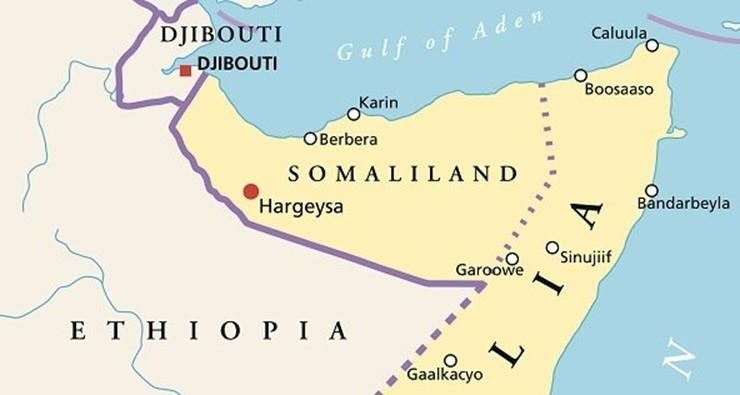
A former British protectorate, Somaliland joined the former Italian Trust Territory of Somaliland to form the new nation of Somalia in 1960. However, after General Siad Barre, the Marxist-Leninist commander of the Somali Army, took control of Somalia in a coup d’état in 1969, he mounted a brutal repression of the Isaaq clan, the dominant clan of the Somaliland region. When Barre fled from power in 1991 in a tank loaded with Somalia’s gold reserves, Somaliland broke with the rest of Somalia to declare independence. Since then, it has struggled to find international recognition as a sovereign state in the face of Mogadishu’s claim that it remains part of Somalia.

A territory of 68,000 square miles and over 6 million people, Somaliland has a highly strategic location on the south coast of the Gulf of Aden near the Bab al-Mandab strait that provides access to the Red Sea and the Suez Canal. Though several states have proved sympathetic to Somaliland, last December Prime Minister Benjamin Netanyahu announced Israel would be the first UN-member state to recognize Somaliland’s independence. Somaliland’s intention to accede to the Abraham Accords was confirmed by Netanyahu on January 30. Problems exist, however, with the legitimacy of the PM’s announcement, as Netanyahu apparently failed to ask for the approval of the cabinet or the Knesset, possibly rendering the recognition invalid under Israeli law. At the center of Netanyahu’s recognition of Somaliland is Israeli access to the port of Berbera, used and expanded for naval use by both the Soviets and later the Americans.

Israel Recognizes Somaliland

Israel’s initiative was opposed by 50 countries and groups, including Somalia, Turkey, Saudi Arabia, Egypt, Qatar, Ethiopia, Djibouti, the African Union, the European Union, the Arab League and the Organization of Islamic Cooperation (OIC). Riyadh described the new partnership as “an action that entrenches unilateral secessionist measures that violate international law.” Qatar suggested that if Israel wanted to recognize new nations, it could start with the State of Palestine.
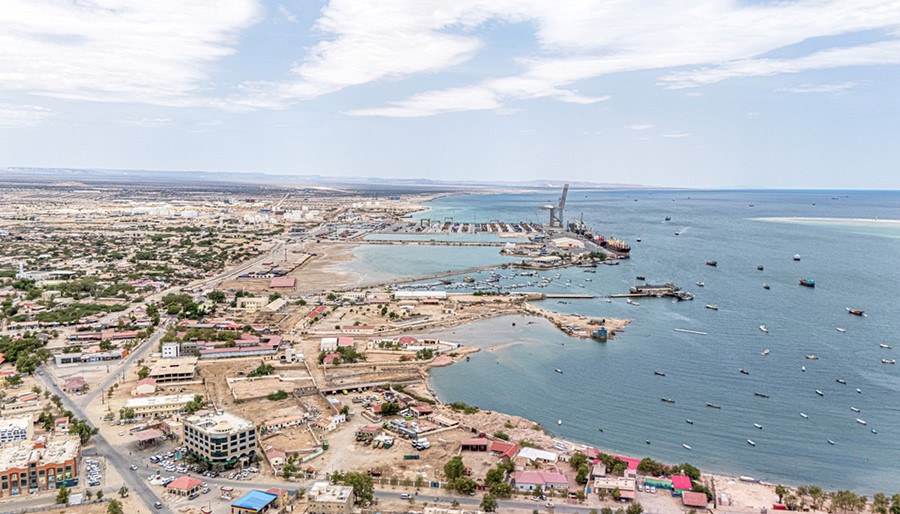
Berbera (Consultancy.Africa)

Israel needs another port in the region; Eilat, its port at the northernmost point of the Gulf of Aqaba, normally gives Israel access to the Red Sea, but after two years of disruption and a Houthi drone strike in September 2025, revenues at Eilat have dropped to zero as the port barely functions. Aware of its exposure,  the IDF carried out military exercises in Eilat on February 12, simulating attacks from both Iran, Yemen and various armed groups.

The Houthi conflict with Israel began in October 2023, with missile strikes on Israeli-bound ships and even Israel. In response, Israel mounted long-range bombing strikes on Houthi targets in Yemen. Use of Berbera’s airstrip for Israeli Air Force operations would reduce flying distance to Yemen by more than two-thirds while allowing for regular manned and drone surveillance operations in the sensitive Gulf of Aden region. At the same time, however, Berbera could become an easily reachable target for Houthi missiles; Houthi leader ‘Abd al-Malik al-Houthi warned that an Israeli presence in Berbera would be a threat to Yemen and Somalia, and would therefore be treated as a “military target.”

Believing that the United Arab Emirates (UAE) had attacked its national unity and sovereignty by facilitating Israel’s recognition of Somaliland, Mogadishu cancelled all agreements with the UAE relating to ports, security and defense, though it has no enforcement power in Puntland or Somaliland. Hersi Ali Haji Hasan, chairman of Somaliland’s ruling Waddani party, defended Somaliland’s agreement with Israel, claiming that “There is no choice before us but to welcome any country that recognises our existential right.” News of the deal brought thousands of residents of the Somaliland capital of Hargeisa into the streets in protest, some waving Palestinian flags. Large protests against the agreement were also observed in most Somali cities.

Despite denials from both Israel and Somaliland, Somalia’s Defence Minister, Ahmed Moalim Fiqi, claimed in January that Somalia had confirmed the existence of an Israeli plan to resettle Gazan Palestinians in the breakaway state, claiming as well that Israel’s recognition of a Somaliland state was part of a regional strategy: “Israel has long had goals and plans to divide countries — maybe for 20 years — and it wants to divide the map of the Middle East and control its countries…  it wants to create a military base to destabilise the region.” Both Hamas and the Palestinian Authority condemned Somaliland’s acceptance of Israeli recognition and suggestions that the territory might act as a destination for expelled Gazans.

Israeli sources quoted a leading member of Somaliland’s foreign ministry on January 8 as saying there are active discussions regarding an Israeli military base at Berbera and the establishment of an embassy in Jerusalem. The official added that accepting Gazans was not part of the agreement with Israel.

DP World Berbera and the Emirati Network

The UAE’s DP World, one of the planet’s largest logistics companies, began a major modernization and expansion of the Berbera port in 2016. DP World holds a 51% stake in the $442 million project, the Somaliland Ports Authority 30% and British International Investment (BII) the remaining 19%. The BII is a development finance institution whose sole shareholder is the UK’s Foreign, Commonwealth & Development Office (FCDO). The BII works “in partnership with DP World to strengthen economic development across the African continent by investing in improving and expanding ports.”
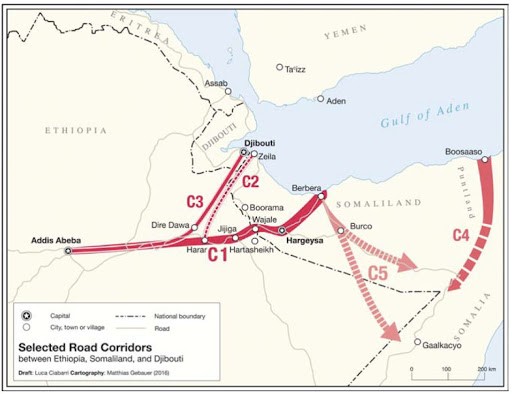
Berbera Corridor (Africa Business Pages)

The project includes the construction of the Berbera Corridor, a highway connecting Berbera to Hargeisa and land-locked Ethiopia. A 2024 agreement laid the groundwork for an Ethiopian lease of facilities at Berbera leading to eventual recognition of Somaliland as a state by Addis Ababa. Berbera will provide a valuable option for Ethiopia, 95% of whose trade currently goes through Djibouti.

In 2017, Hargeisa agreed to the establishment of an Emirati naval and air base near the Berbera commercial port. The site includes an existing Soviet-built 4km-long runway, once leased by NASA as an emergency landing strip for the space shuttle. US Africa Command has inspected the airport twice recently, in 2022 and 2025. Berbera is now one of a network of Emirati bases established around the Red Sea region and the Gulf of Aden, including the port of Bosaso in neighboring Somali Puntland, the Yemeni port of Mocha and various islands, including Mayun, a strategically important rock in the middle of the Bab al-Mandab.

In July 2025, Somaliland offered to host a US military base at Berbera and grant access to critical mineral resources in exchange for diplomatic recognition. The White House, however, demonstrated no interest; asked for comment on the offer last December, President Trump replied “Big deal,” adding: “Does anyone know what Somaliland is, really?”

Conclusion

Somaliland’s growing relations with Israel are a bold gambit to attract international recognition at the risk of alienating other potential regional partners. Israel is likewise antagonizing important nations already signed on to the Abraham Accords in order to have one small, non-Arab country join the pact. Israel’s motivation is more likely to be found in its perceived need to create alternative access points to the Red Sea and to not be left out of the ongoing militarization of the Red Sea as tensions increase with Iran and its Houthi supporters in Yemen. In the process, Somaliland risks becoming a target for the Islamic State and al-Qaeda (al-Shabaab), both of whom operate in Somalia.

The German Blockade of Venezuela and the Renewal of the Monroe Doctrine, 1902-1903

Andrew McGregor

Royal Canadian Military Institute SITREP

February-March 2026

Origin of the Dispute

German involvement with Venezuela began in the period 1528-1526, when Holy Roman Emperor Charles V granted colonization rights in the region to Nuremburg’s House of Welser. Though this early effort failed when Spain reasserted its control, German trading houses had become a prominent part of the Venezuelan economy by the end of the 19th century.

During Venezuela’s 1898 civil war, the nation’s foreign population was leaned on for forced loans and also suffered the seizure of property. When strongman Cipriano Castro took power in 1899, he halted payment of all foreign debts, mistakenly believing that he would be protected from foreign intervention by America’s Monroe Doctrine. Endless instability, illegal detentions and Castro’s extortionate demands led to a flow of complaints to Berlin. Struggling to suppress a rebellion against his rule, Castro even imposed his own blockade on several Venezuelan port cities.

Venezuelan President Cipriano Castro

The German foreign office announced on December 13, 1901 that it intended to collect the money owed to German citizens by means of a blockade, with the option of occupying Venezuelan harbors to collect duties if necessary. Germany and the US had nearly come to blows over Samoa in 1889 and again over the Philippines in 1898 (see AIS Historical Perspective).

President Theodore Roosevelt was a firm supporter of the Monroe Doctrine, presenting it to South American leaders as a means of defending their sovereign rights and territory against European nations. On December 3, 1901, Roosevelt declared to Congress that the doctrine did not “guarantee any state against punishment if it misconducts itself, provided that punishment does not take the form of acquisition of territory by any non-American power.” In plainer language, Roosevelt assured a German diplomat: “If any South American country misbehaves toward any European country, let the European country spank it.” There appeared to be no American objection to a European blockade of Venezuela, provided it had a limited purpose.

European Challenges to the Monroe Doctrine

SMS Panther

The Venezuelan crisis came at a time when European nations were acting in the Caribbean with little regard to the Monroe Doctrine. In June 1902, a French cruiser seized a Venezuelan gunboat after Castro threw seven French merchants in prison. That summer, a British ship claimed the uninhabited island of Patos, between Trinidad and Venezuela, without US objection. The German gunboat Panther sank the Haitian rebel gunship Crête-à-Pierrot in September 1902 after it had seized a German steamer carrying arms for the Haitian government. Though the Panther’s action was described as illegal and excessive, the US State Department did not consider it a threat to the supremacy of the Monroe Doctrine.

The Iron Clad Agreement

On November 11, 1902, Kaiser Wilhelm and his uncle King Edward VII signed what was termed an “iron-clad agreement” to jointly pursue their claims against Caracas. This alliance between Britain and Germany, no matter how specific and temporary, proved massively unpopular with the British public.

HMS Charybdis Seizing the Venezuelan Gunboat Bolivar (1891) at Port of Spain in Trinidad.

The agreement benefited the Germans significantly, offering a military and political shield against American objections to naval action while permitting access to British ports in the Caribbean. The Kaiser told his officials: “The more ships the British send the better. The more our action fades into the background and theirs takes the foreground, the better. Of course we will follow the British program…  Let’s leave the British up front.”

As storm clouds gathered, America prepared for a possible conflict. On November 21 the four battleships of the US North Atlantic Squadron joined the four cruisers and two gunboats of the Caribbean Squadron off the island of Culebra, near Puerto Rico. More ships would join them there, all under the command of Admiral George Dewey, the hero of 1898’s Battle of Manila Bay.

Naval Forces of the Blockade

A British “Particular Service Squadron” under Commodore Robert AJ Montgomerie was sent as the British contribution to the blockade, consisting of the armored cruiser HMS Charybdis (1893), the protected cruiser HMS Retribution (1891), a sloop and a destroyer. Vice-Admiral Archibald Douglas arrived later on his flagship, the HMS Ariadne (1898) and took command of the blockading forces.

SMS Vineta

The German East American Cruiser Squadron was deployed on blockade duty on December 9, 1902. Most of the German ships had extensive experience in Germany’s African and Pacific colonies. The squadron was commanded by Commodore Georg Scheder, who had worked with British ships during the suppression of an uprising in Samoa in 1894. The squadron was composed of the protected cruiser and flagship SMS Vineta (1897), the light cruiser Gazelle (1898), the unprotected cruiser Falke (1891) and the gunboat Panther (1901). (SMS = Seiner Majestät Schiff, His Majesty’s Ship). These were joined on December 20 by the corvette Stosch (1879), the training ships Charlotte and Stein and the collier Siberia.

Italian Cruiser Giovanni Bausan

When an Italian demand for debt repayment was rejected by Castro on December 11, Rome decided to join the blockade. The protected cruiser Elba (1893) was joined by two larger cruisers, the Carlo Alberto (1896) and the Giovanni Bausan (1883). Their deployment, opposed by the Germans, attracted little attention in the US and barely figured in the diplomatic wrangling that followed.

Restaurador under German flag, with the Gazelle in the background.

On December 9, 1902, German and British ships begin to seize Venezuelan naval ships. The SMS Gazelle seized the Venezuelan gunboat Restaurador (1883, a former American steam yacht sold to Venezuela in 1900) on December 11 and pressed her into German service on the blockade.

On December 13, Castro made a show of force by seizing a British merchant ship, the SS Topaze, and arresting its crew. Enlisting the aid of the SMS Vineta, the HMS Charybdis shelled the two fortresses protecting the harbor of Puerto Cabello. The shelling had little effect, so British and German crewmen went ashore to blast the fortresses with explosives while freeing the Topaze and liberating its crew. The allied response unnerved Castro, who released all the British and German nationals in his jails.

The Bombardment of Fort San Carlos

On January 17, 1903, the Panther pursued a merchant ship trying to evade the blockade into the shallow waters of Lake Maracaibo. The German gunship came under fire from the guns of nearby Fort San Carlo. The Panther’s bow gun jammed responding to the fire and the ship was unable to bring its other guns to bear properly due to problems maneuvering. After half an hour the Panther retired.

Vineta and Panther shelling Fort San Carlos in January 1903 (Le Petit Parisien)

With the Venezuelans celebrating their “triumph” over the Panther, the Germans acted without the lead of the British commander, who had been warned to avoid further actions such as the bombardment of Puerto Cabello. The German flagship Vineta shelled Fort San Carlos on January 21. The fort was heavily damaged and set afire, but the Venezuelan defenders had already withdrawn.

A dispute over who fired first turned into a PR disaster for the Germans, who came under attack in the American press for their “Teutonic savagery” despite British confirmation that the Venezuelans had fired first.

Arbitration

As the blockade grew into a crisis during December 13-18 1902, Germany came to be blamed by the US press. In the British press and parliament naval cooperation with Germany was generally viewed as unnecessary and even undesirable, especially since the UK and Germany had different views of the Monroe Doctrine. While Britain had few problems with it, Otto von Bismarck described the Monroe Doctrine as “a species of arrogance peculiarly American and inexcusable.”

The focus of the German foreign office shifted to the need to avoid irritating British public and political opinion over a relatively minor conflict and a debt of little consequence amidst fears that England might withdraw and leave Germany in the lurch as the sole target of American discontent. Arbitration, as proposed by Castro, came to look like an adequate, if not optimal, way of avoiding a confrontation with the Anglo-American powers. By December 17, the Germans had consented to arbitration, though the blockade continued.

Roosevelt’s 1916 Claims

Claims made by Teddy Roosevelt in 1916 at a time when he was urging American entry into the war against Germany forced a reinterpretation of the Venezuelan crisis. Roosevelt insisted he had threatened the Germans (through their ambassador) with Dewey’s powerful fleet if they failed to accept arbitration, though extensive searches have failed to uncover a single document to support his claim. In a letter to Alfred Mahan that same year, Roosevelt offered a new description of Germany’s aims in 1902: “Germany intended to seize some Venezuelan harbor and turn it into a strongly fortified place of arms . . . with a view to some measure of control over the future Isthmian [Panama] Canal, and over South American affairs generally.”

The Roosevelt Corollary

With the crisis over, Roosevelt warned in December 1904 that in cases of “chronic wrongdoing” in the Western Hemisphere, “the adherence of the United States to the Monroe Doctrine may force the United States, however reluctantly, in flagrant cases of such wrongdoing or impotence, to the exercise of an international police power.”

What came to be known as the Roosevelt Corollary to the Monroe Doctrine asserted an American right to intervene in Western Hemisphere states unable to pay their international debts, a self-declared “right” that was designed to discourage further European military interventions.

The Monroe Doctrine was now to be used as justification for American intervention in the Western Hemisphere. It is Roosevelt’s corollary that formed the basis for repeated American interventions in Latin America in the 20th and 21st centuries, and could even be applied against Canada as a result of “chronic wrongdoing,” as interpreted by the current US administration.

The new Trump Corollary (or “Donroe Doctrine”) asserts American dominance over all nations in the Western Hemisphere, including the right to impose direct rule over these nations on self-defined grounds of economic or security-related necessity. With its rejection of existing alliances and trade agreements, it embodies a significant alteration of the original intent of the Monroe Doctrine and even the Roosevelt corollary. This is seen clearly in President’s December 2025 assertion that “America…will not allow a Hostile Regime to take our Oil, Land, or any other Assets, all of which must be returned to the United States, IMMEDIATELY.”

German Corvette SMS Stosch

Conclusion

The Venezuelan blockade ended with a February 13, 1903 commitment from Castro to make restitution to Germany, the UK and Italy through an agreed-upon payment plan. All seized Venezuelan commercial and naval ships were returned. The blockade ended on February 23, 1903, though the American fleet did not disperse until April 30, 1902. When American authorities found it impossible to avoid accepting a statue of Frederick the Great as a gift from the Kaiser in 1905, a Washington daily suggested sending Wilhelm a statue of James Monroe in return.

It has been suggested that assembling the US fleet at Puerto Rico under the command of known Germanophobe Admiral Dewey was a scheme by Roosevelt, the navy and arms manufacturers to create a war scare with Germany that would enable greater naval appropriations from Congress. In a more straight-forward sense, it was likely hoped Dewey’s presence would deter German attempts to land troops or seize territory. While Roosevelt warned of a future conflict with Germany, America would ultimately prove reluctant to challenge German naval might in 1914 and only entered the First World War in 1917 when German naval power had already been contained.

BIBLIOGRAPHY

Bowen, Herbert W: (1919) “Roosevelt and Venezuela,” The North American Review 210(766), September 1919, pp. 414-417.

Dodson, Aidan: (2016) The Kaiser’s Battlefleet: German Capital Ships 1871–1918, Barnsley: Seaforth Publishing.

Dodson, Aidan, and Dirk Nottleman: (2021) The Kaiser’s Cruisers 1871–1918, Annapolis: Naval Institute Press.

Dorn, Herbert: “Germany in Latin America,” Current History 28(163), March 1955, pp. 168-176.

Fenton, PF: (1928) “Diplomatic Relations of the United States and Venezuela, 1880-1915,” The Hispanic American Historical Review 8(3), August 1928, pp. 330-356.

Forbes, Ian LD: (1978) “The German Participation in the Allied Coercion of Venezuela 1902–1903”, Australian Journal of Politics & History 24(3), pp 317–331.

Herwig, Holder H: (1986) Germany’s Vision of Empire in Venezuela, 1871-1914, Princeton University Press.

Hildebrand, Hans H.; Albert Röhr and Hans-Otto Steinmetz: (1993) Die Deutschen Kriegsschiffe: Biographien – ein Spiegel der Marinegeschichte von 1815 bis zur Gegenwart, Vol. 3, Mundus Verlag, Ratingen.

Kshyk, Christopher J: (2015) “Roosevelt’s Imperialism: The Venezuelan Crisis, the Panama Canal, and the Origins of the Roosevelt Corollary,” Inquiries Journal 7(3).

Livermore, Seward W: (1946) “Theodore Roosevelt, the American Navy, and the Venezuelan Crisis of 1902-1903,” The American Historical Review 51(3), April 1946, pp. 452-471.

Maass, Matthias: (2009) “Catalyst for the Roosevelt Corollary: Arbitrating the 1902–1903 Venezuela Crisis and Its Impact on the Development of the Roosevelt Corollary to the Monroe Doctrine,” Diplomacy & Statecraft 20(3), pp. 383–402.

Mitchell, Nancy: (1996) “The Height of the German Challenge: The Venezuelan Blockade, 1902-3,” Diplomatic History 20(2), Spring 1996, pp. 185-209.

Mitchell, Nancy: (1999) The Danger of Dreams: German and American imperialism in Latin America, University of North Carolina Press.

Morris, Edmund: (2002) “’A Matter of Extreme Urgency’: Theodore Roosevelt, Wilhelm II and the Venezuela Crisis of 1902, Naval College War Review 55(2), pp. 73-85.

Nottelmann, Dirk: (2020) “The Development of the Small Cruiser in the Imperial German Navy,” in John Jordan (ed.). Warship 2020, Osprey Publishing, Oxford, pp. 102–118.

Penfield, WL: (1903) “The Anglo-German Intervention in Venezuela, North American Review 560, July 1903, pp. 86-96.

Schieber, Clara Eve: (1921) “The Transformation of American Sentiment towards Germany, 1870-1914,” Journal of International Relations 12(1), July 1921, pp. 50-74.

Ricard, Serge: (2006) “The Roosevelt Corollary,” Presidential Studies Quarterly 36(1), March 2006, pp. 17-26.

Türk, Titus (1904): 75 Tage an Bord des Kreuzers “Restaurador”: Aus dem Tagebuch eines Seemannes, Borchers, Lübeck.

Vagts, Alfred: (1939) “Hopes and Fears of an American-German War, 1870-1915,” Political Science Quarterly 54(4), December 1939, pp. 514-535.